


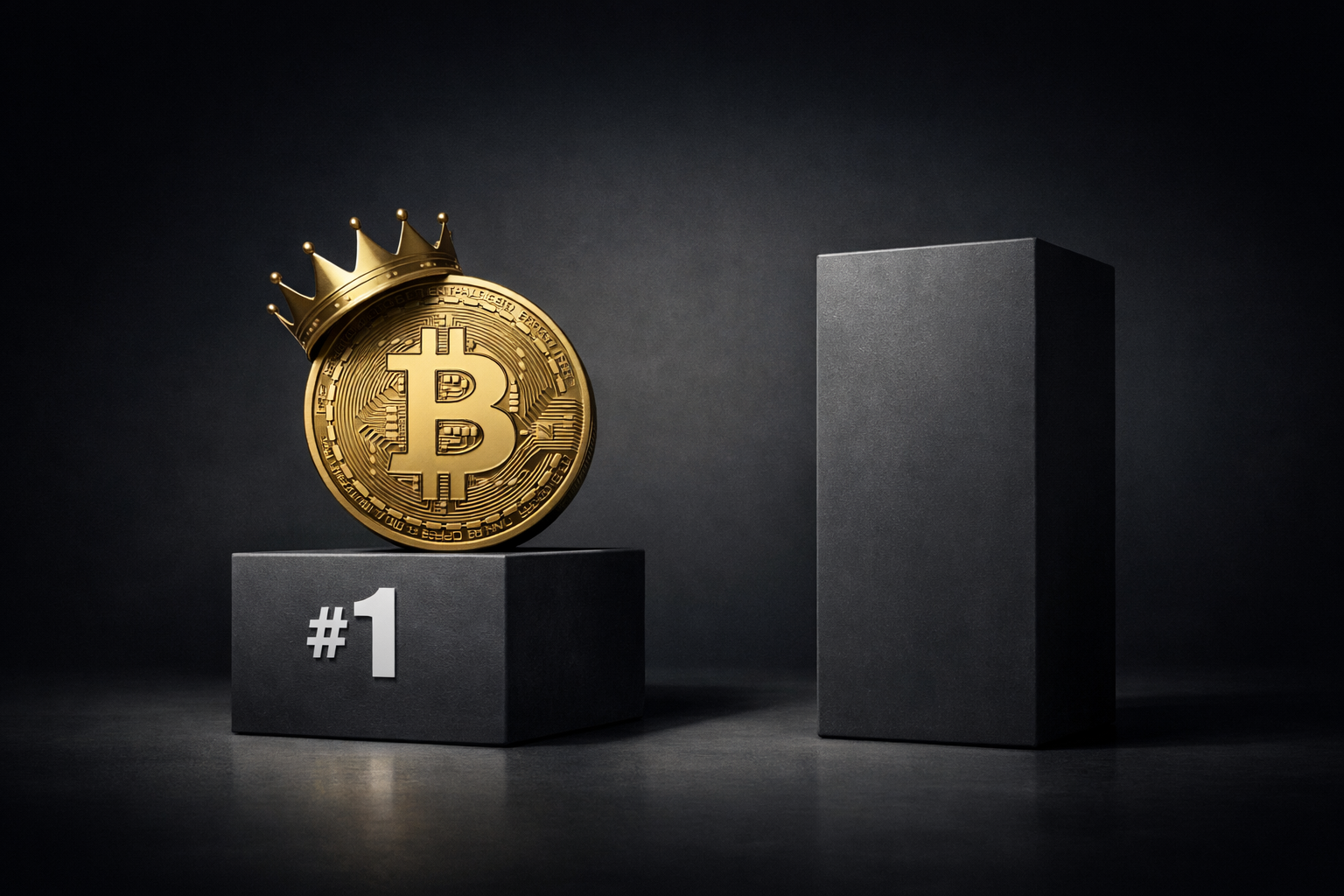
Who Will Replace Bitcoin at the Top
We are used to seeing Bitcoin at the very top of the cryptocurrency rankings by market capitalization. It often feels as if that position is secured forever. But I am almost certain that this will change very soon. Someone else will take that spot. Let me explain why.
A tectonic shift many are underestimating
In the US, Depository Trust & Clearing Corporation has received approval from the SEC to tokenize securities held in custody - more than $100 trillion worth of assets. The project is scheduled to launch in the second half of 2026.
This is not an experiment or a sandbox. For the first time in history, Wall Street's central securities depository is moving core infrastructure onto blockchain for full-scale, production use.
Just think about the growth potential. According to RWA.xyz, the total value of tokenized real-world assets currently stands at $24.4 billion and continues to accelerate. The number of holders of RWA tokens has grown by 36.5% in just one month.
That means this market cycle will likely bring a massive expansion in the capitalization of real-world assets on-chain.
Seventeen years of undisputed dominance
For all 17 years of blockchain's existence, Bitcoin has been the largest crypto asset by market capitalization. No other asset ever came close to seriously challenging it. It is no coincidence that at a Bitcoin conference in Miami in 2023, one speaker summed it up this way: "Bitcoin evolves much more slowly than altcoins because, unlike altcoins, Bitcoin has no competitors."
At the time, that statement was largely true. Bitcoin entered finance with a radically new idea and introduced three revolutionary principles:
- Secure self-custody. Anyone can hold their own money without compromising security.
- Permissionless transfers. Funds can be sent even against the wishes of banks, governments, or payment systems.
- Independence of value. The value of money should not depend on the actions of governments or central banks.
The idea of value may sound confusing today. After all, the BTC/USD rate reacts sharply to statements by politicians or officials at the Federal Reserve. But this is where an important distinction matters.
The BTC/USD price reflects Bitcoin's value as measured by actors within the fiat financial system. Bitcoin was never designed to function inside that system. It was designed as an alternative to it.
When Bitcoin advocates say that 1 BTC always equals 1 BTC, they are not talking about fiat exchange rates. They are talking about an invariant principle: 1 BTC equals 1/21,000,000 of all value recorded on the Bitcoin blockchain. In that sense, the value of one bitcoin inside the system remains constant, even if its value shifts in other reference frames.
Why Bitcoin had no competitors
Other cryptocurrencies tried to build financial systems based on principles similar to Bitcoin's. But they never had a real chance.
First, Bitcoin had an enormous head start in time, creating a network effect so powerful that no alternative cryptocurrency could realistically catch up.
Second, Bitcoin is protected by an unprecedented amount of computational power. Today, its total hash rate is close to 1000 EH/s. That is roughly 10,000 times more computing power than all the world's supercomputers combined. No attacker - and no state - can realistically challenge that level of security. No other cryptocurrency comes anywhere close.
For these reasons, it never made sense to treat other cryptocurrencies as serious competitors to Bitcoin, at least in the fundamental aspects Bitcoin brought into finance.
The arrival of real competitors
That changed with the emergence of stablecoins, followed by other tokens tied to traditional financial assets. At that point, it became clear that Bitcoin's notion of value, as described above, is not intuitive for most people.
Be honest with yourself: did you fully understand it? Many people either do not understand it, or understand it but do not agree that a form of value meaningful only within the Bitcoin community - large as it may be - truly qualifies as value.
Value becomes real when your neighbor understands it. When your taxi driver understands it. When your teacher understands it. When the talking head on TV understands it. Bitcoin felt like that kind of value in 2017 and in 2021. It does not feel that way today.
Stablecoins: a competitor with intuitive value
Look at what is happening. Bitcoin is being used less and less. Competition for block space has been steadily declining for almost two years. The average transaction fee has fallen from 100 sat/vB at the beginning of 2024 to 0.16 sat/vB at the beginning of 2026.
Stablecoins, meanwhile, are being used more and more. Their value is easy to understand, which makes them real competitors to Bitcoin in the eyes of ordinary users. Stablecoin market capitalization has grown from $20 billion in 2020 to $310 billion in 2026. USDT alone processes around $190 billion in transactions every day - more than Visa.
Stablecoins appear to offer the same benefits as Bitcoin:
- Self-custody
- Permissionless transfers
- Most importantly for everyday users: value stability
In reality, this is mostly an illusion:
- When you use stablecoins, you do not own dollars and do not hold them. The dollars sit in a bank, not even in your account but at best in the issuer's account. At least two entities can deny you access to what you supposedly own. What you hold is a tokenized record, not the asset itself.
- Most stablecoin transfers are possible only between addresses approved by the issuer. Major issuers like Tether and Circle regularly freeze addresses holding millions of USDT or USDC directly at the smart contract level.
- Stable value exists only in fiat terms. In real purchasing power, it steadily erodes due to inflation. Over the last decade alone, the dollar has lost about 25% of its purchasing power.
But most people are not interested in these nuances. They choose stablecoins over Bitcoin.
A new competitor with an unprecedented advantage
For the same reasons that made stablecoins popular, other tokenized real-world assets are likely to gain traction as well.
We already see this with tokenized gold - PAXG and XAUT. The same will happen with tokenized securities. Everyone knows them. They have been considered valuable for centuries. Their value is far easier for the masses to grasp than Bitcoin's.
The global markets for equities, bonds, and real estate amount to hundreds of trillions of dollars. Combined, they are roughly 200 times larger than the entire crypto market. These are precisely the assets whose value your neighbor, your taxi driver, your teacher, and the talking head on TV already recognize. Which means you recognize it too.
Bitcoin is now facing a competitor with the same kind of network-effect advantage over Bitcoin that Bitcoin once had over other cryptocurrencies.
Within this market cycle, we will see crypto assets whose market capitalizations exceed Bitcoin's by multiples. Tokenized securities, real estate, commodities, and metals all have the potential to dominate the top of the crypto market rankings and push Bitcoin down in the near future.
Stablecoins as the new unit of account
So what will become the unit of account for these assets? What will we use to buy and sell them?
Certainly not funds held in bank accounts. Banks are too slow and constrained by regulation. Try buying a large amount of crypto with money from your bank account and you will quickly find yourself explaining your finances to compliance departments. Meanwhile, USDT can be exchanged for any crypto asset on rabbit.io at any time, with no limits.
I believe fiat currencies themselves will not be the primary medium of exchange. Their tokenized forms - stablecoins - will be. And to handle the massive volumes entering the crypto market, we will need equally massive supplies of stablecoins.
As a result, stablecoins will also climb higher in market capitalization rankings than Bitcoin.
The paradox of the technology
The outcome is paradoxical. A technology originally designed to enable maximum financial sovereignty is now being used for the opposite purpose.
Instead of owning real assets, we will own only their representations on a blockchain. The assets themselves will remain fully controlled by entirely different parties.
But there is another side
Bitcoin was not only an alternative to fiat currencies. It was also an alternative to banks. And banks appear to be losing ground.
Just a year or a year and a half ago, customer support at rabbit.io regularly received requests from users who wanted to buy or sell crypto using bank money. Since we do not work with banks, we could not help them.
Today, such requests are almost gone. People who hold assets on blockchains no longer need money in banks.
Stablecoins played a key role in this shift. You cannot pay for everything with Bitcoin or other cryptocurrencies, but you can already pay for almost everything with stablecoins - directly or via crypto payment cards.
Yes, those cards are issued by banks. But the difference is that we do not need to become their customers or keep our money there. Even with all the intermediaries involved, stablecoins still reduce the end user's reliance on banks.
What comes next?
I believe we are not far from a world where the exchange of USDT for EURI is more commonplace than the exchange of USD for EUR. I have little doubt that all finance will eventually move onto blockchains.
At first, mass adoption will favor traditional financial instruments. They will almost certainly take Bitcoin's place at the top of CoinMarketCap in the foreseeable future.
But everything has its time. Bitcoin's fundamental advantages are not going anywhere, just as the flaws of fiat currencies remain. When tokenized traditional finance reaches its limits - centralized control, censorship, dependence on intermediaries - people will once again remember the value of financial freedom.
Bitcoin will have its moment again.