



Can TON Pay Turn Telegram into a Crypto Service?
This is a story about how Apple has been keeping cryptocurrencies at arm’s length for more than a decade - and why TON Foundation’s new initiative is unlikely to change that overnight.
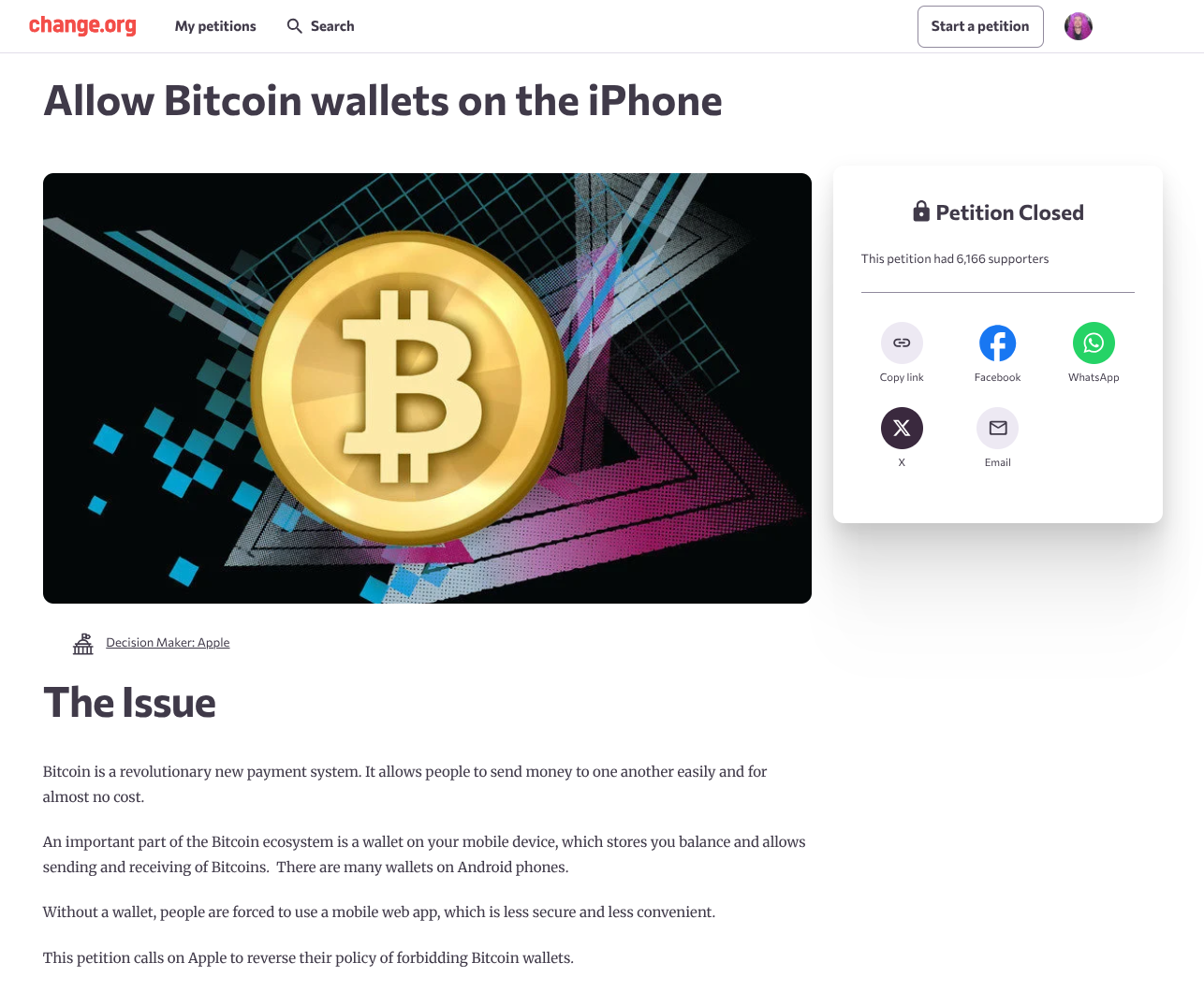
Screenshot of a 2014 petition demanding the return of Bitcoin wallets to the iPhone
This week, TON Foundation announced the launch of a new software platform for building crypto payment solutions: TON Pay. Commentators were quick to call it a major step toward turning Telegram into a crypto checkout layer.
But people have been predicting Telegram’s crypto transformation for years - ever since Nikolai and Pavel Durov first unveiled Telegram Open Network, the project that eventually evolved into today’s TON. And yet Telegram is still not a crypto service in the way enthusiasts imagined.
Even inside Telegram itself, Toncoin never became the primary payment currency. For a while, it looked inevitable. Instead, the main unit of account for in-app payments became Telegram Stars - a virtual currency that has nothing to do with crypto. You buy Stars with fiat money, and a portion of that payment goes to the app stores. Apple and other app stores need this money, not crypto.
So the question is: will it be different this time?
We have been here before. Many times. And the story almost always ends the same way: anyone who tries to push through Apple’s barriers gets crushed. Let’s unpack why.
A Tax on Gas
Let's start with one of the most absurd episodes.
In late 2022, Coinbase rolled out an iOS update to its wallet. The feature was simple: users could send NFTs to one another. But sending anything on a blockchain requires paying a network fee - gas - to miners or validators.
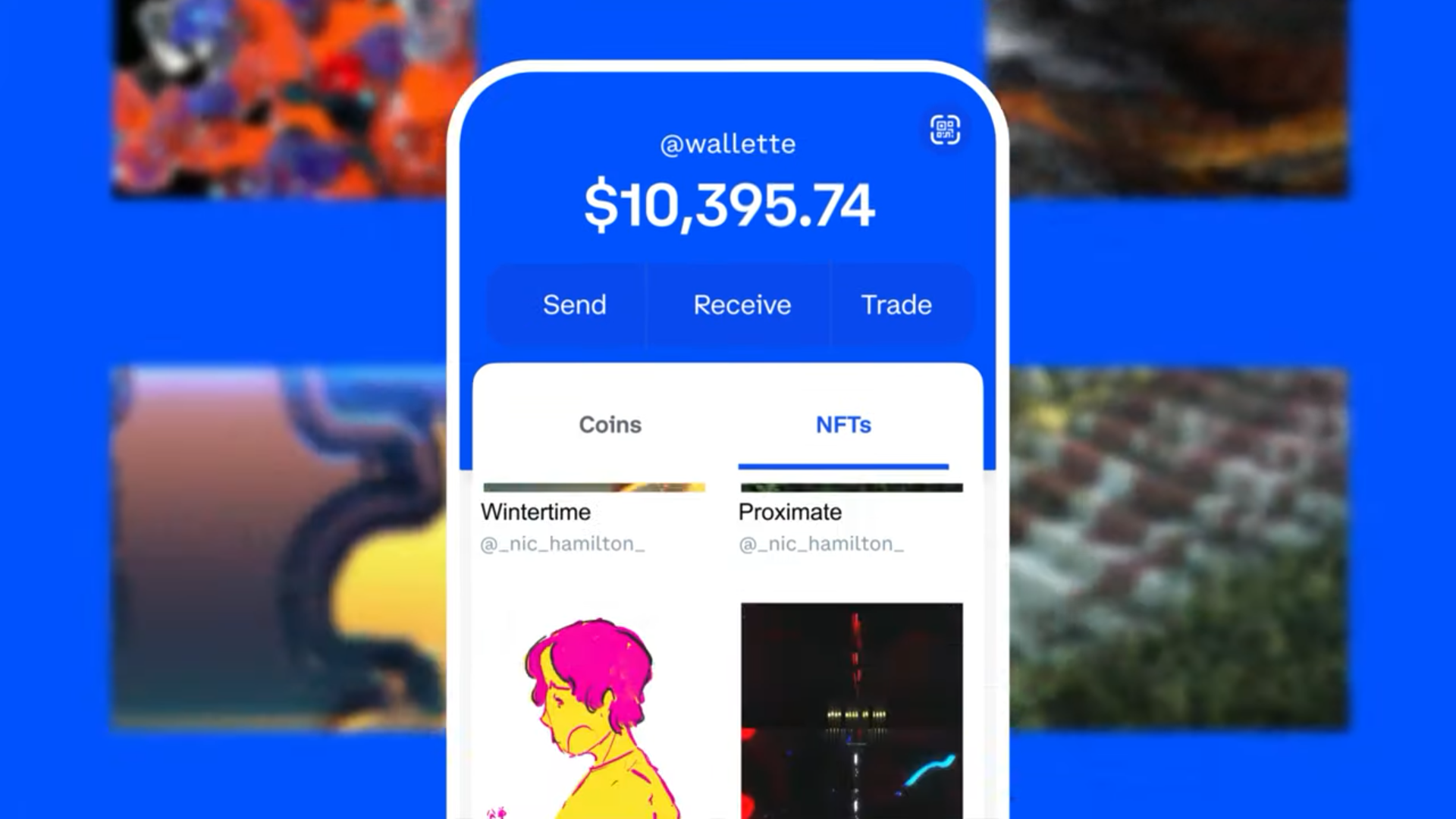
NFT in Coinbase Wallet. Screenshot from a 2022 demo video
Apple blocked the update. Its demand: any fee associated with NFT transactions had to go through Apple’s in-app purchase system - with a 30 percent commission.
Technically, Coinbase could have tried to engineer a workaround. It could have forced users to buy ETH with fiat inside the app before each transaction, adding enough markup to cover Apple’s cut. But who would use such a wallet? It would appeal only to a narrow audience: people who want to store officially purchased JPEGs on their phones but prefer paying fiat plus a hefty markup instead of interacting directly with crypto.
For everyone else, the demand was absurd. Coinbase described it perfectly at the time: it was like Apple trying to charge a fee for every email sent over open internet protocols.
In the end, Coinbase simply removed the NFT transfer feature from its iOS app.
Quietly, other wallets continued offering similar functionality. Apple did not enforce the same demand across the board. Coinbase became a test case. If even Coinbase refused to pay, it would have been nearly impossible to force smaller developers to comply. Had Coinbase agreed, we might be living in a very different model of crypto integration on mobile today.
The Early Wars
The Coinbase Wallet case was far from unique - and it certainly wasn’t the first.
Let’s rewind to 2014. Do you remember the Blockchain app? At the time, it was the most popular Bitcoin wallet among mainstream users. It worked perfectly well on iOS - until the day Apple removed it from the App Store without warning. The official explanation was vague: an “unresolved issue.”
So what was the issue?
Apple accused the wallet of attempting to bypass the official in-app purchase system that all applications are required to use. The developers of Blockchain responded sharply, calling it a monopolistic practice designed to eliminate competition in payments.
In effect, Apple established a principle that would shape the next decade: users may conduct Bitcoin payments through apps only if the App Store receives its cut. That precedent set the tone for years to come. Crypto payments, Apple signaled, must follow the same rules as fiat payments. Otherwise, they simply will not exist inside iOS apps.
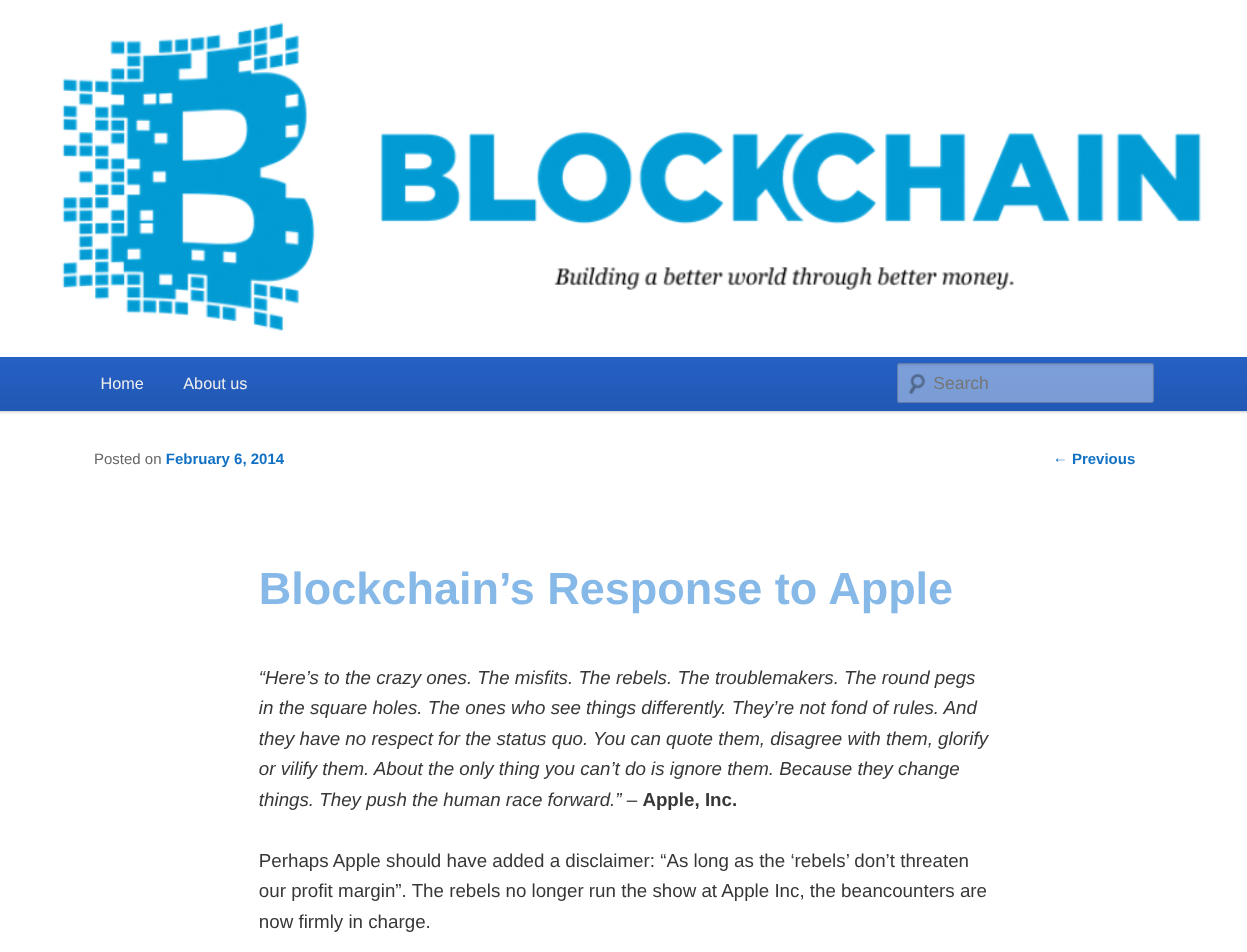
Blockchain.info blog post about the wallet’s removal from the App Store
Google also carried out its own purge of crypto applications - but for very different reasons.
In 2018, MinerGate Mobile Miner, an app promising easy money, turned out to be a scam. Users believed their Android phones were mining Bitcoin. In reality, the app did nothing except display a fake animation.
Google responded by updating its policy: “We don’t allow apps that mine cryptocurrency on devices.” It removed MinerGate and dozens of similar apps from Google Play, regardless of whether they were fraudulent or merely inefficient.
But unlike Apple’s actions, this crackdown had nothing to do with crypto payments - even though Google, like Apple, collects a commission on standard in-app purchases.
Lesser-Known Casualties
Some stories are less famous but equally revealing.
Damus and the Forbidden Tips
There’s a project called Damus. It’s a client for decentralized communication built on the Nostr protocol. Functionally, it looks like a social network: you can follow accounts and see updates in a feed.
Like most Nostr clients, Damus includes a tipping feature for content creators. If you like a post, you can send the author a few satoshis via the Lightning Network. It costs almost nothing for the reader, and it’s a nice gesture for the author.
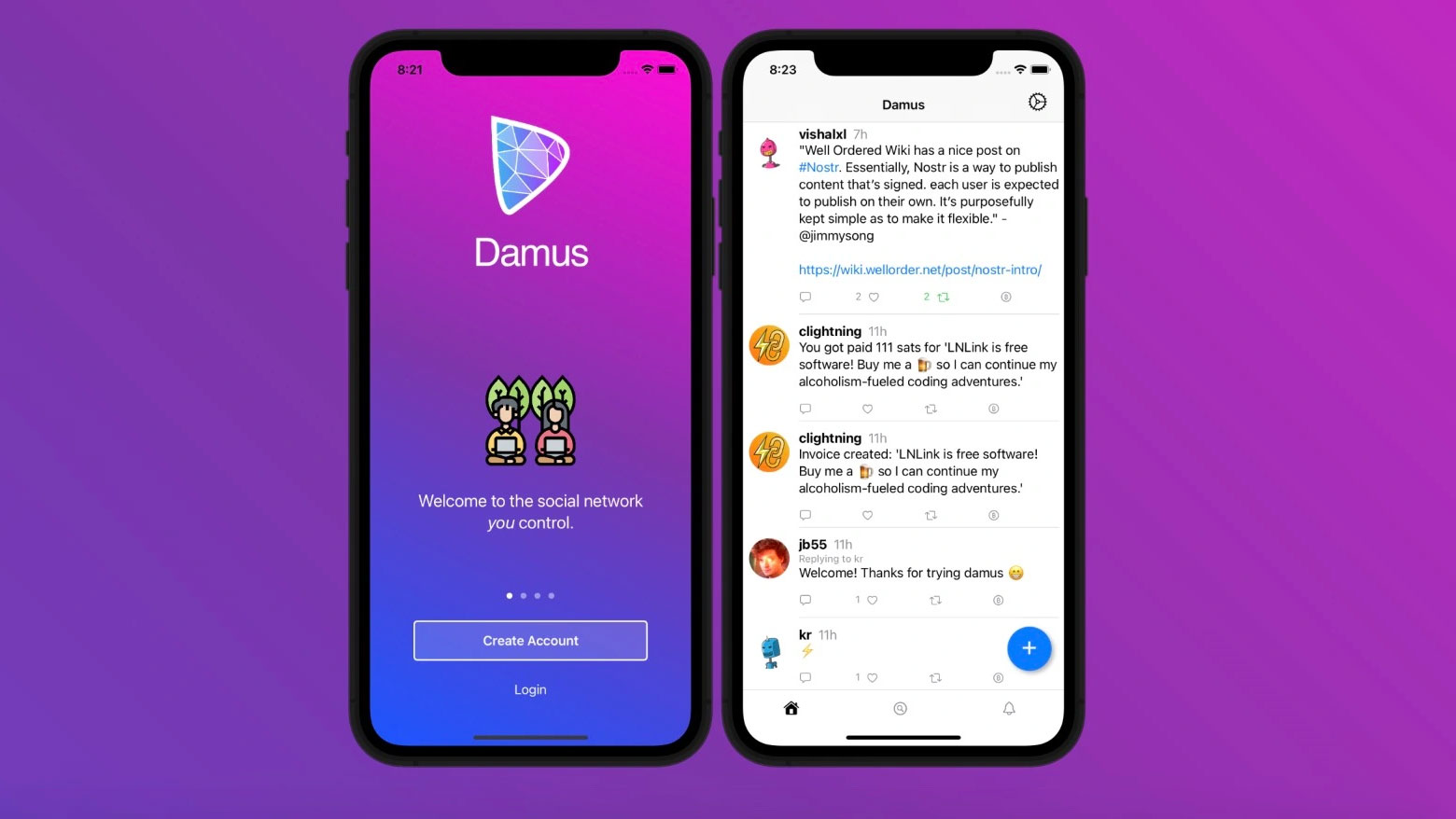
Damus for iOS. Source: TechCrunch
Let me stress this: tipping is standard across Nostr clients. But only Damus ran into trouble - precisely because it was built first and foremost as an iOS app.
Apple classified a tip attached to a post as a purchase of digital content. And under App Store rules, any digital content sold inside an iOS application must go through Apple’s payment gateway - with a 30 percent commission.
The developers argued that voluntary tips are not purchases. They are simply peer-to-peer transfers, expressions of appreciation. Apple did not care. The choice was blunt: remove the tipping feature, or the app will be removed.
Damus removed the ability to tip posts on iOS.
StepN and the Age of Crutches
Remember the hype around StepN, the “move-to-earn” app? You ran with your phone, and in return you earned tokens. To get started, you had to buy virtual NFT sneakers - priced in SOL.
Apple prohibited selling NFTs for cryptocurrency inside the app. And that is when the crutches appeared.
StepN introduced an internal currency called “Sparks,” specifically for iPhone users. The logic was simple - and painfully artificial:
- You buy Sparks with regular money via Apple Pay, at an inflated price that quietly absorbs Apple’s 30 percent commission.
- You then use Sparks to buy the NFT sneakers inside the app.
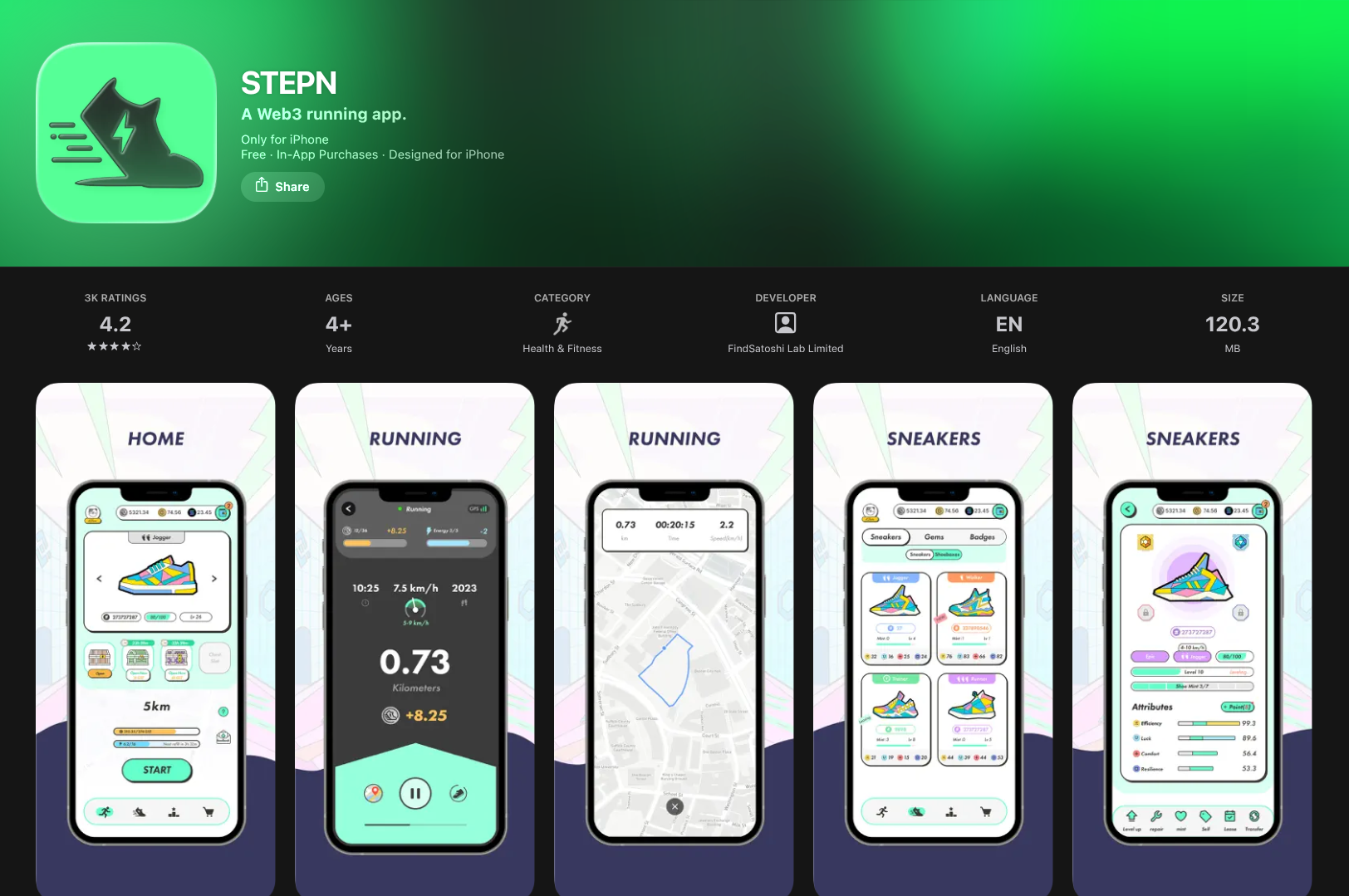
StepN in the App Store
Sparks were not innovation. They were crutches. A way to keep walking inside Apple’s ecosystem without getting thrown out of it.
And even crutches don’t always help.
The mobile NFT marketplace Sticky tried something similar. It introduced its own in-app currency, StickyCoins, allowing users to buy digital collectibles. But that did not save it from removal.
Ironically, Sticky was banned not for using blockchain too aggressively - but for not using it properly. Its NFTs were not minted on public blockchains; the token database was accessible only to Sticky users. Apple called that misleading.
The reasoning was debatable. In Bitcoin’s early days, blockchain data was effectively accessible only through Bitcoin Core. But by then it was clear: survival in the App Store had little to do with technical purity. It had everything to do with interpretation - and power.
Battle of the Titans
For a long time, it was a one-sided game. Apple dictated the rules. Developers complied.
But in August 2020, one developer decided to fight back. And it was not a small startup. It was Epic Games - the creator of Fortnite, one of the most popular video games in the world.
Epic did what no one else had dared to do. It deliberately added a direct payment button to the mobile version of Fortnite, offering players a 20% discount on in-game currency if they paid outside Apple’s system.
Apple reacted instantly. Within hours, Fortnite disappeared from the App Store.
But Epic had planned for this. On the same day, it filed a multi-billion-dollar lawsuit and released a pre-produced video titled "Nineteen Eighty-Fortnite" - a parody of Apple’s iconic 1984 commercial, in which Apple had positioned itself as the rebel fighting IBM’s monopoly. This time, Apple was cast as Big Brother.
Five years of court battles followed - lawsuits, appeals, counterclaims. For most of that time, Apple prevailed. Courts repeatedly affirmed its right to control its own ecosystem.
But on April 30, 2025, Judge Yvonne Gonzalez Rogers ruled in Epic’s favor. The decision fundamentally changed the landscape: Apple can no longer charge commissions on external purchases, and it cannot restrict how developers reference or link to external payment systems.
This ruling is not directly about cryptocurrencies. But it opens the door for developers to process payments outside their apps - through third-party systems, theoretically including crypto - without paying Apple a commission and without submitting to its payment controls. At least in the United States.
In the rest of the world, Apple’s rules largely remain the same.
There is, however, another exception. In Europe, the Digital Markets Act has forced Apple to open its ecosystem to alternative app stores and alternative payment systems.
Telegram Stars
So what does all of this have to do with TON Pay and the idea of turning Telegram into a crypto service?
The history of crypto integration in Telegram is, in many ways, the distilled essence of everything described above.
Telegram once looked like the perfect candidate for deep crypto integration. Telegram’s lead developer, Nikolai Durov, originally designed the Telegram Open Network (TON) blockchain specifically for Telegram itself. After the U.S. SEC forced the Durov brothers to abandon the project in 2020, TON was revived by an independent team - formally unaffiliated with Telegram - under the name The Open Network.
By 2023-2024, it increasingly seemed that Toncoin, TON’s native token, was about to become Telegram’s primary currency.
In September 2023, Telegram launched TON Space - an integrated TON wallet inside the app. In April 2024, advertisers were encouraged to use Toncoin to pay for advertising.
It looked like Telegram was on the verge of becoming a true crypto service.
But it didn’t.
- In May 2024, Telegram sent notices to developers of payment-accepting bots stating: “Apple has informed Telegram that ****bot is in violation of App Review Guidelines 4.7 and 3.1.1, because it accepts payments for digital goods and services directly from customers without relying on Apple's in-app purchase mechanism.”
- In June 2024, Telegram launched Telegram Stars - an internal virtual currency purchased with fiat money through Apple’s and Google’s payment gateways. Stars, not Toncoin, became the primary method of payment inside Telegram for subscriptions, stickers, premium features, and other digital upgrades.
- Telegram explicitly emphasized: “Starting on June 12, all payments for digital goods and services in bots and mini apps will have to be carried out exclusively in Telegram Stars.” No exceptions.
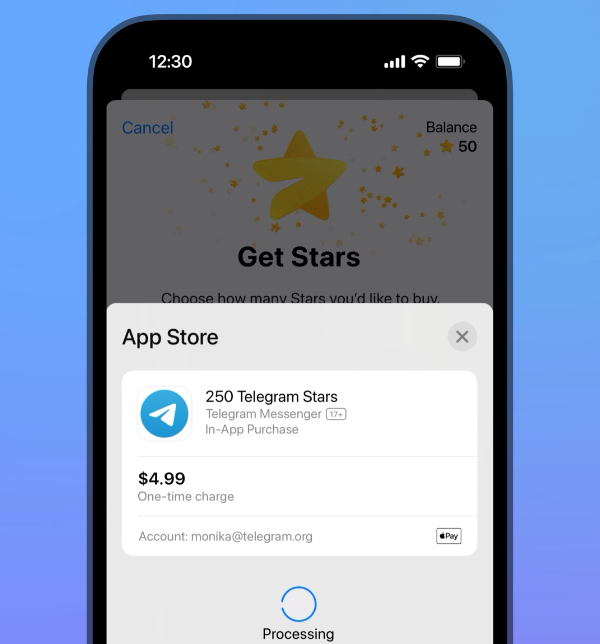
In other words, Telegram did not become a titan like Epic Games. It became another app leaning on crutches - much like StepN.
What Could TON Pay Change?
TON Pay is an SDK for accepting payments via the TON blockchain. Transactions settle almost instantly - theoretically up to 100,000 per second. Fees are microscopic - less than a cent. Everything is designed to integrate seamlessly into Telegram Mini Apps.
Under current rules, payments for digital goods inside mini apps must be processed exclusively through Stars. But here is the interesting part: Telegram Mini Apps are essentially web applications. They run inside Telegram’s interface, but they are not part of Telegram’s native codebase.
The payment itself takes place within a web page. The user confirms it through a wallet. The funds move directly to the seller on the blockchain.
That model looks very similar to what emerged from the Epic vs. Apple court ruling: an external payment flow. Formally, Apple cannot dictate the terms of such payments - at least not in the United States.
It is a tactical bypass. And it might work. With caveats.
Where TON Pay Could Win
It will almost certainly work for physical goods and non-digital services. App store rules allow alternative payment methods for those categories. That is why Uber can process card payments without Apple taking a 30% cut.
TON Pay could become a standard payment layer for these use cases inside Telegram Mini Apps.
The flow might look like this:
- You order pizza through a mini app.
- You tap “Pay with TON.”
- The crypto is transferred to the merchant in a fraction of a second with a negligible fee.
You don’t even need to open a separate wallet - it is integrated into Telegram.
For cross-border commerce, micropayments, and real-world services, this model could be highly competitive.
Where TON Pay Will Struggle
Digital goods inside the app are a different story.
Channel subscriptions. Premium stickers. In-game currencies. Unlocking bot features. All of these currently rely on Stars, because they fall squarely under the rigid 30% commission rule. If developers attempt to bypass that rule using TON Pay, Telegram risks sanctions or even removal. And we already know Telegram is not ready to escalate into a serious confrontation with Apple.
Yes, after the 2025 court decision in the United States, developers can direct users to external websites for payment. But the United States is not Telegram’s largest market.
The Dream Meets Reality
Will TON Pay turn Telegram into a fully fledged crypto payment service?
Most likely, no. At least not in the sense that crypto enthusiasts imagine. Telegram is unlikely to become a place where a billion users make everyday purchases in Toncoin seamlessly and without intermediaries. Not because the technology is flawed - but because a giant with an apple logo controls the gateway to half of the mobile world.
The story of TON Pay is just another episode in the long-running tension between the philosophy of decentralization and the reality of centralized platforms. Blockchain technology can organize finance without intermediaries - but the most powerful intermediaries control the devices through which we access that finance.
You can build the fastest blockchain in the world. The lowest fees. The smoothest integration. But if your application can only be distributed through a centralized repository, then you have to play by that repository’s rules. And those rules were not written for the financial revolution. They were written to preserve the status quo.
A Different Path
But there is a solution.
And without false modesty, I would suggest that developers of crypto services take a close look at the experience of the crypto swapping service Rabbit.io.
On our platform, you can pay with any cryptocurrency and receive any other in return. You can do this on any device and any platform, without paying an additional commission to the platform owner. Why? Because access to our service does not require a dedicated app. Everything happens directly in the browser.
It does not matter whether you are using a desktop computer, a laptop, a tablet, or an iPhone. You open a browser, go to https://rabbit.io, choose the exchange direction, send one cryptocurrency, and receive another.
Apple cannot prohibit this. Even Apple will not go so far as to remove every web browser from the App Store.
If Telegram wants to become a truly successful crypto service, it could follow a similar path. App store rules do not apply to web versions of services. That means that deeper integration of TON Pay with Telegram may depend on strengthening Telegram’s web-based experience. Only then could TON Foundation’s new SDK enable a genuine payment revolution.
The user base is already there. The infrastructure is improving. The legal landscape is shifting. But as long as Telegram’s core experience lives inside tightly controlled mobile ecosystems, the crypto revolution will have to coexist with the realities of centralized gatekeepers.