


Bitcoin Never Became Money. Will the Forks Change That?
This summer, Bitcoin has found itself in a strange position: two separate teams are trying to "save" it. And they are trying to save it from two completely opposite problems, using two completely opposite approaches.
Some say Bitcoin has become too rigid and too afraid of new features, so a parallel chain should be created and given what the main network never dared to adopt. Others say Bitcoin has, on the contrary, become too loose, allowing the blockchain — that is, the files on the hard drives of its most dedicated users — to become a storage for other people's images, tokens, and inappropriate content. Therefore, Bitcoin must be called to discipline and returned to its role as money.
Perhaps these are two different debates. But I believe this is a debate about the same thing: what actually happened to the project that Satoshi Nakamoto called a "peer-to-peer electronic cash system"? The answer today is not very pleasant. As internet money, Bitcoin is losing. And it is not losing to banks, to Visa or PayPal, but to a new competitor — the dollar packaged into stablecoins.
What Happened to Bitcoin?
The most illustrative example is El Salvador. In 2021, the country became the first to make Bitcoin legal tender. It looked like a historic breakthrough, like opening a floodgate that could no longer be closed. But in January 2025, after an agreement with the IMF, the law was changed: businesses are no longer required to accept Bitcoin. And no one was particularly upset, because businesses never really needed it anyway. The backbone of Bitcoin transactions in the country had long been the neobank Blink, which showed users their balances and transaction amounts in dollars in its interface, using Bitcoin ecosystem components only as a transport layer.
While Bitcoiners were conducting their debates, users were voting with their wallets. Chainalysis estimates that in 2025 stablecoins processed $28 trillion in transactions with real economic significance. The company explains this growth through the strong advantages of stablecoins: instant settlement, low costs, convenient transfers, and transparent B2B payments. The European Central Bank in May 2026 explained this trend even more simply: payment systems require a stable asset, while most cryptocurrencies are too volatile. Therefore, stablecoins currently function as the main form of money in the digital environment.
Chainalysis and the ECB are, of course, interested parties — each in their own way. But Reuters recently drew attention to the fact that in Nigeria, households and small businesses are increasingly using dollar stablecoins for cross-border transfers. Many other media outlets have repeatedly observed similar trends at the grassroots level in other countries. Transfers in tokenized dollars are faster, cheaper, and more understandable than any alternatives, which is especially important in countries with weak national currencies.
In other words, even when escaping inflation of weak currencies, users are no longer turning to hard money with limited issuance, but to the ordinary dollar — just in a new format.
For me, this is the main and unified backdrop for both of these very different summer forks: Bitcoin has undoubtedly moved away from the center of attention of the crypto industry and its users.
The eCash Hard Fork
The first of the upcoming forks is eCash, a project by Paul Sztorc. Sztorc has long promoted the idea of drivechains — sidechains that would allow experimentation with new features and pay rewards to ordinary Bitcoin miners for securing their networks. In BIP-300 (a proposal to implement this idea into Bitcoin's main code), it is described as a system where, after creating a miner-controlled bridge between L1 and L2, users could move coins between layers, and Bitcoin could theoretically process all transactions in the world without changing the base layer.
But convincing Bitcoin's developers to accept this idea has not worked. So Sztorc and his collaborators decided not to ask permission from Bitcoin developers anymore and instead launched their own separate chain. eCash is designed to be a copy of Bitcoin with the drivechain proposal activated. The launch is scheduled for block 964,000, approximately in August 2026. Native eCash tokens will be distributed among most Bitcoin holders in a 1:1 ratio.
I highlighted "among most Bitcoin holders" in bold because there is an interesting nuance here: the coins attributed to Satoshi Nakamoto. Slightly more than half of those coins will remain on the same addresses in the new chain, while the rest will be distributed among the investors who are currently funding the development of eCash.
And here eCash undermines its own foundation. It offers a fairly clear diagnosis: Bitcoin is losing because it can do too little — there is no convenient base-layer scaling, privacy is achieved through complex methods, new applications move to other networks, and even Lightning, which is already ten years old, has still not become a universal payment system for everyone. From this diagnosis follows a clear conclusion: the market needs a different Bitcoin, one that is open to experimentation. But tell me — would any Bitcoiner agree to move to a network where half of the creator's coins have been stolen?
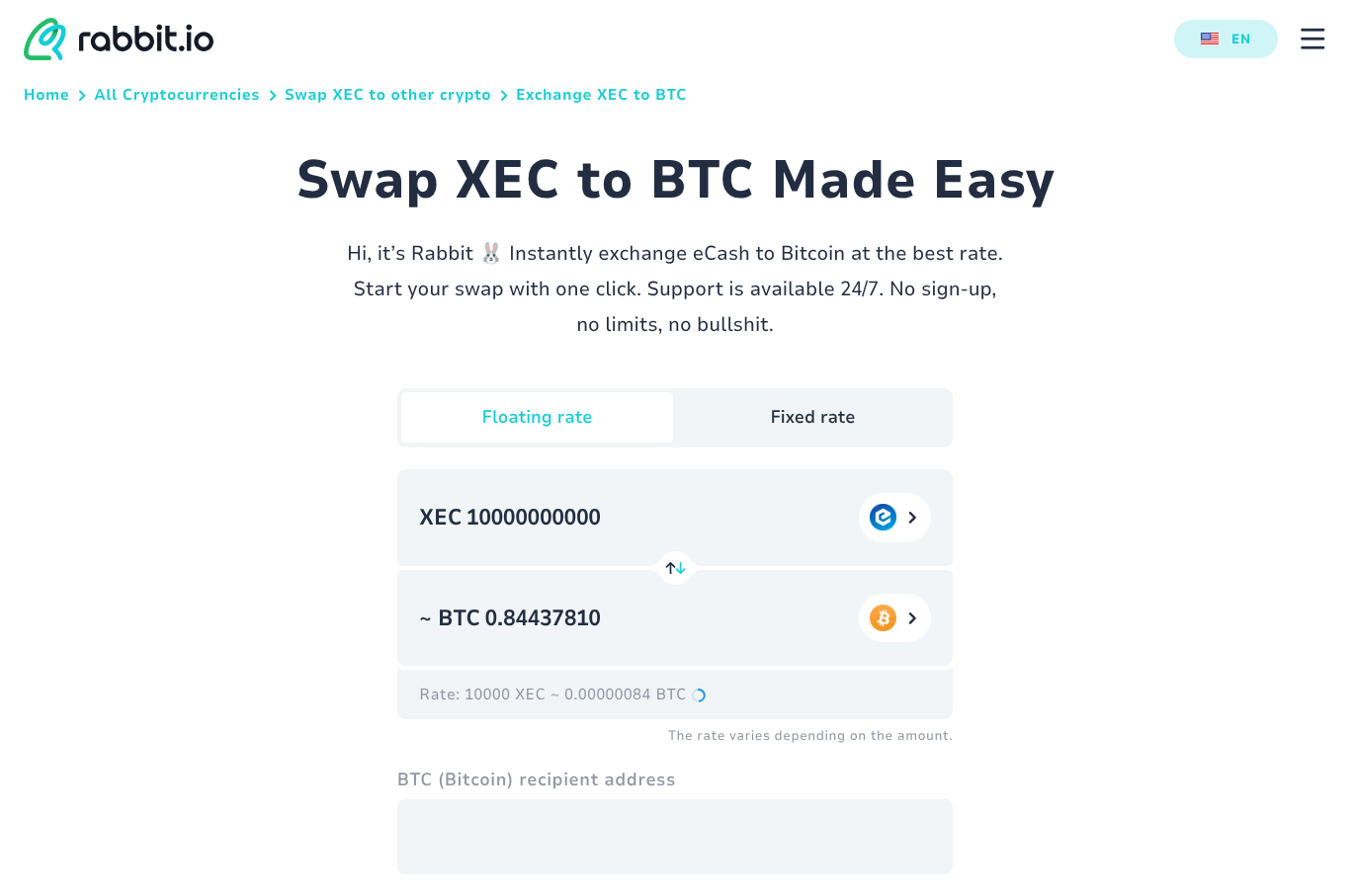
The name eCash also feels strange. Not only are there already several projects with this name in the crypto world, but one of them is itself a Bitcoin fork. It is not widely used and has almost no value. On rabbit.io you can exchange XEC (eCash token) for any cryptocurrency, but even with the best exchange rates, the reality is that XEC remains very low in value.
At the same time, no matter how little demand the current eCash has — why launch another fork with the same name and create additional confusion? I can already imagine the complications on exchanges. Someone wants to exchange their crypto assets for eCash — which of the two eCashes should they choose?
(Spoiler: if in doubt — contact the support chat at rabbit.io, and we will help you figure it out quickly.)
Anyway, enough product placement — back to the topic.
BIP-110 Activation
The second fork this summer is the activation of BIP-110. Formally, this is not expected to split the chain, since it is designed as a soft fork, and a temporary one at that. Its supporters want to limit arbitrary data in transactions for one year: impose size limits on certain transaction components and exclude from the blockchain any transactions that exceed those limits. The goal is to return the focus to using Bitcoin as money and remove the incentives for storing arbitrary data in the blockchain.
If eCash says that Bitcoin failed to become money because it was not allowed to develop and offer users new features, then BIP-110 says the exact opposite: Bitcoin will not become money if it tolerates every possible use case. For BIP-110 supporters, Ordinals, Runes, NFT images, and similar uses of block space are an abuse of infrastructure in which all full node operators voluntarily store other people's data without receiving any compensation.
What makes BIP-110 dangerous is the activation mechanism chosen by its supporters. BIP-110 requires miners to add a signaling flag to their blocks, confirming that the miner agrees with the BIP-110 update. Activation is scheduled for block 965,664, at the very end of summer. If blocks without this flag appear during that period, nodes supporting BIP-110 must reject them as invalid. Because of this, an update conceived as a soft fork could lead to a genuine chain split.
How Bitcoin Core Responds
The most interesting part is that core developers are, at this time, taking a third path. They are not trying to "save" Bitcoin from any of these problems. It seems that in their worldview, these problems simply do not exist.
In Bitcoin Core 30.0, the default -datacarriersize was increased to 100,000 bytes and multiple non-spendable OP_RETURN outputs were allowed in a single transaction. For BIP-110 supporters, this looked like a surrender to "spam." But Core's motivation was different: Gloria Zhao explained in her note to the change that it was an attempt to standardize the data storage method, so that data senders would not need to negotiate directly with one of the miners for inclusion in the blockchain — that is, so as not to strengthen centralized transaction submission channels.
Bitcoin Core 31.0's focus is also telling: improved transaction replacement logic, private transaction broadcasting via Tor and I2P, and similar improvements. This is routine work on relay and reliable handling of edge cases.
So while fork supporters argue about the spirit of Bitcoin, Core quietly adjusts the existing mechanisms, as if nothing unusual is happening.
My Forecast
I believe neither eCash nor BIP-110 will restore Bitcoin's status as universal digital money.
eCash may become an interesting experiment for those who want to see "Bitcoin that was not afraid of innovation." But it will not affect actual BTC in any way — it will create a separate asset with its own risks and the difficult unresolved question of Satoshi's coins.
BIP-110 may give some supporters of "pure Bitcoin" a sense of returning to its origins. However, other supporters of "pure Bitcoin" who were present at its origins believe the opposite: that pure Bitcoin is a system where no one imposes usage rules on others. But even if this contradiction did not exist, BIP-110 cannot affect the reasons people choose USDT or USDC: BTC volatility, inconvenient UX, unpredictable fees, and unfamiliar units of value. It is simply devoted to a different problem.
Therefore, these forks are important not as a remedy, but as a symptom. They show that Bitcoin's current crisis is a crisis of role. One camp wants to make Bitcoin a platform for experimentation, another wants to narrow it down to strict money, while Core developers try to maintain neutral infrastructure. And the market has already responded in its own way: for payments it needs stability and convenience, for savings it needs understandable risks, and for ideology it does not need Bitcoin at all.
Finally, I recommend looking at both forks from a practical angle. Bitcoin holders will have the chance to receive free coins in two new chains. Each fork is essentially an airdrop, in altcoin terms.
And if we can receive a reward simply for holding Bitcoin at our own addresses — perhaps now is the right time to start accumulating.
The best exchange rate for converting any cryptocurrency to Bitcoin is at rabbit.io.