


BIS Says Stablecoins Aren't Real Money. But Its Argument Cuts Both Ways
The Bank for International Settlements (BIS) has released its annual macroeconomic report, laying out its view of the global economy, financial risks, inflation, sovereign debt, the role of central banks, and the future of money.
The section that will interest crypto enthusiasts most is Chapter 4: "Anchoring trust in money: innovation beyond stablecoins." The title might suggest that BIS wants to restore trust to a monetary system where leading cryptocurrencies - Bitcoin, Monero, and others - were designed to remove the need for it. But that impression is misleading. The chapter is really about custodial stablecoins whose issuers hold customer funds - primarily USDC and USDT. Using these stablecoins has always required trust, and on two levels: trust in the issuers themselves, and trust in the financial institutions where those issuers keep users' money.
When BIS talks about trust, what it is actually proposing is to bring the technological benefits of tokenization inside the existing banking and central bank infrastructure. The report's authors argue that stablecoins, on their own, fail to function as proper money.
Their reasoning goes like this:
- For money to work as money, the monetary system must be unified: every dollar used in settlement should be interchangeable with every other dollar.
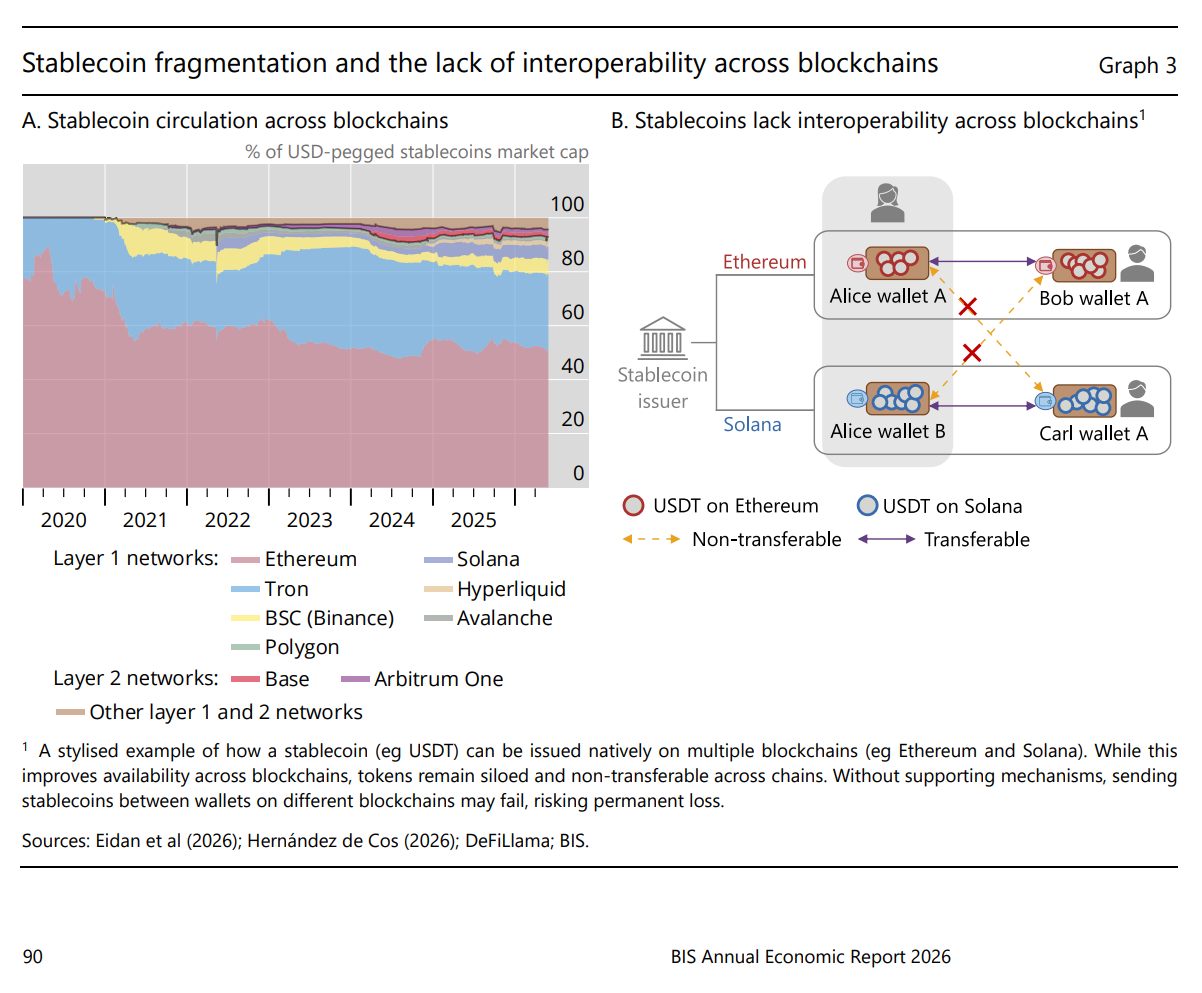
- Today's stablecoins do not meet that standard, because no one guarantees par-value exchange between different issuers or across different blockchains.
It is a curious argument coming from an international organization of central banks. BIS should know better than anyone that money issued by one central bank cannot be guaranteed to exchange at par for money issued by another central bank. And it certainly understands that money deposited in a bank cannot be easily converted back from deposits into cash.
Stablecoins work in much the same way. Issuers like Tether and Circle play the role that central banks play in the traditional system, while tokens on different blockchains are roughly analogous to different forms of money.
So if stablecoins fail as money for this reason, then the same criticism applies to central bank money as well.
Yes, nobody guarantees that USDT on Ethereum can be exchanged at par for USDC on Ethereum, or for USDT on Tron. But just as with traditional money, market-rate exchange is always available. On rabbit.io, that exchange is open to everyone: no red tape, no limits.