


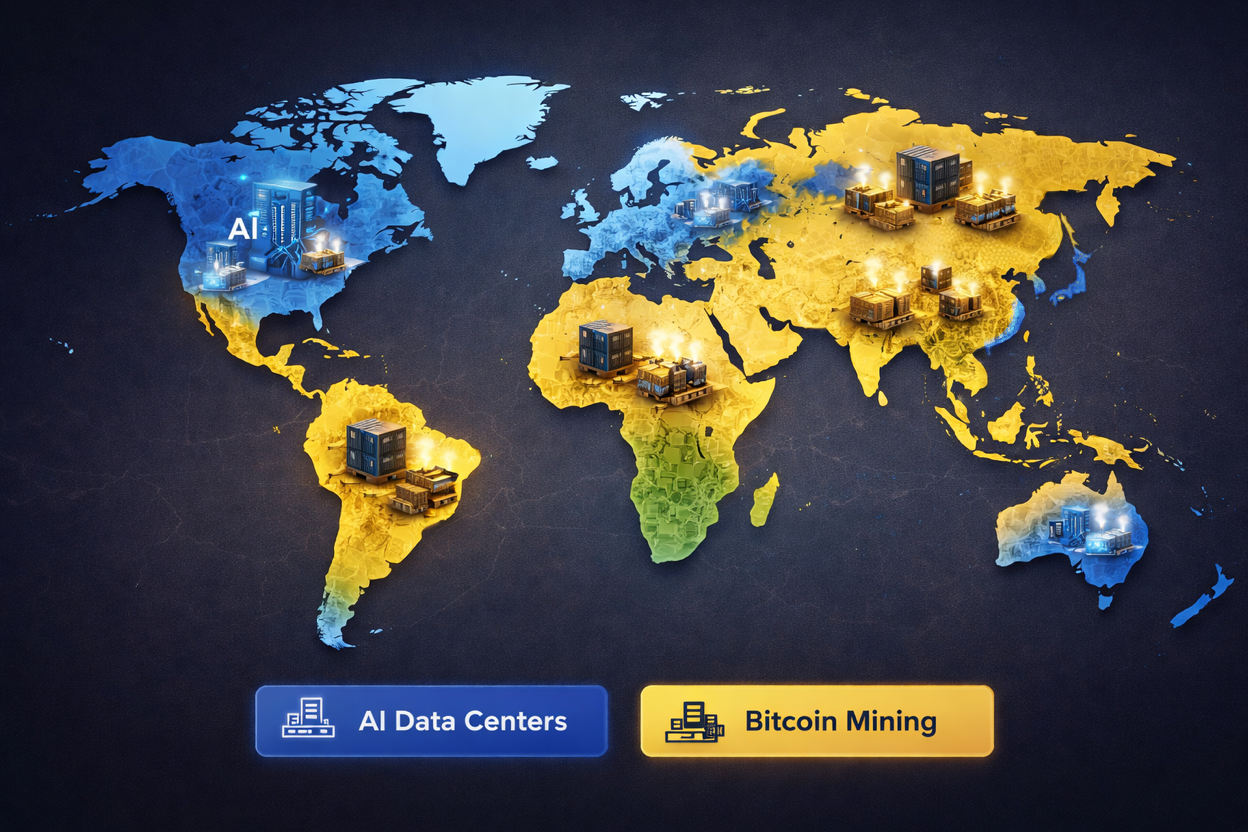
Who Gets the Power: Bitcoin or AI?
Artificial intelligence and cryptocurrencies are not just competing for hardware and computing power. They are competing for the most basic resource of civilization: electricity.
A few days ago, I wrote on the rabbit.io blog about the dilemma facing Laos’s energy sector: for five years, excess electricity was sold to miners, but now the government is considering redirecting it toward AI.
This competition is still rarely discussed openly, yet it is already reshaping investment decisions, national policies, and the future of energy itself. Within just a few years, Bitcoin has gone from being labeled an “energy vampire” to being seen as an almost ideal consumer of electricity - and now it is being challenged by AI, which also demands enormous amounts of power. Those who once criticized Bitcoin for wastefulness may now feel vindicated: the argument is no longer just about consumption, but about scarcity. There may simply be no surplus energy left.
Public opinion has come full circle. Now it must decide, once again, whether Bitcoin deserves a place at the table.
Part I: The Dirty Villain
Between 2017 and 2021, a reliable media genre took hold: the Bitcoin apocalypse story.
- “Bitcoin consumes more energy than Argentina”
- “One Bitcoin transaction equals 49 days of electricity for a U.S. household”
- “Its carbon footprint rivals that of entire countries”
In 2021, a single tweet by Elon Musk wiped 15% off the market within hours. Tesla stopped accepting Bitcoin “due to environmental concerns.” Greenpeace launched its “Change the Code, Not the Climate” campaign. Lawmakers around the world called for bans. The verdict seemed clear: guilty.

Source: greenpeace.org
To be fair, the criticism was not baseless. The logic is simple: the higher Bitcoin’s price, the more miners join; the more miners join, the harder the puzzle; the harder the puzzle, the more energy is consumed - and there is no finish line.
By 2025, according to the Cambridge Centre for Alternative Finance, Bitcoin was consuming about 138 TWh per year - roughly 0.5% of global electricity usage. That is comparable to the consumption of countries like Norway or Poland. Its carbon footprint was estimated at 39.8 million tons of CO₂ equivalent annually - lower than early alarmist headlines suggested, but still significant and supported by research.
E-waste was also a real concern: obsolete ASIC machines cannot be repurposed and are often discarded.
The environmental concern was most acute before 2021, when China dominated global mining and operators freely tapped cheap coal from Inner Mongolia. Beijing's mining ban that year forced the industry to relocate - and that's when an unexpected plot twist began to unfold.
Part II: An Unexpected Rehabilitation
Bitcoin's critics had the right data but were asking the wrong question. They asked: "How much energy does Bitcoin consume?" The better question is: "What kind of energy does it consume - and what would have happened to that energy otherwise?"
Unlike oil, gas, or grain, electricity is nearly impossible to store. At almost every moment, generation must match consumption exactly. When a grid produces more than it can absorb, that surplus must be curtailed - simply switched off and wasted.
The scale of this problem is substantial. In the UK, compensation paid to wind farm operators for forced downtime reached around £1.9 billion per year by 2025. In Texas, where wind generation is massive, hundreds of millions of dollars in potential revenue evaporate overnight, when demand drops to its lowest and turbines keep spinning with nowhere to send the power.
Miners found this niche and moved in. Their key advantage is radical flexibility. A mining farm can spin up or shut down in seconds. It doesn't need continuous power - unlike a hospital or a factory. It can be set up anywhere in the world: all it needs is internet and a socket. It's willing to buy electricity wherever and whenever no one else wants it.
In Texas, grid operator ERCOT launched a voluntary demand response program in December 2022 for large flexible consumers: miners agree to cut their load instantly during peak stress periods, and get paid for it. In August 2023, during an extreme heat wave, one of the largest mining operators, Riot Platforms, received $31.7 million from ERCOT in a single month - simply for switching off its machines when the grid was under strain. And during low-demand periods, it would absorb as much power as possible and earn on that too. This wasn't charity: it was payment for a guaranteed presence - a promise to stay connected, not defect to competing grids, and to provide high consumption precisely when the generator needs it. A genuine symbiosis.
One telling detail: that same August, Riot earned just $8.6 million from actually mining Bitcoin. The payment for doing nothing was 3.5 times larger than the revenue from mining itself.
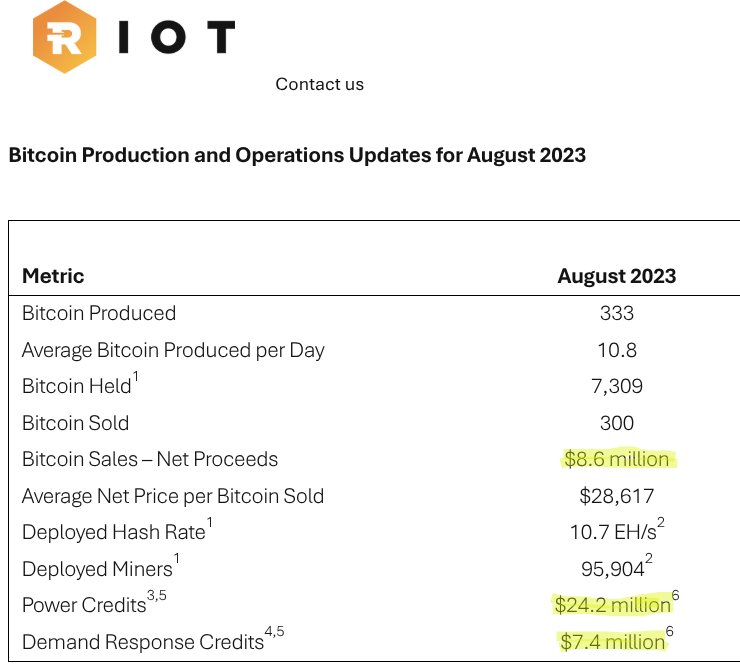
Screenshot from riotplatforms.com
A Cambridge study published in April 2025 found that sustainable energy sources now account for 52.4% of the Bitcoin mining mix - roughly double the green-energy share across other industries. The United States leads this shift, with American miners making the most aggressive use of surplus wind and hydro generation.
Then there's the flared gas opportunity. Oil wells around the world burn off billions of cubic meters of associated gas every year, or vent it directly into the atmosphere. Either way it's an economic loss, and direct venting is an environmental one too: methane is dozens of times more potent than CO₂ as a greenhouse gas. Mining companies have begun deploying mobile containers directly at wellheads, using that gas to generate electricity on-site. What was previously burned with no economic benefit - or even vented into the atmosphere - is now converted into a source of energy for mining, while also reducing methane emissions through more complete combustion.
There's an important caveat here, though. When miners build permanent infrastructure and connect to the grid as a stable, continuous load, they're no longer mopping up a surplus - they're creating new demand. Laos is the cautionary tale: the government encouraged mining to monetize excess hydropower, but by 2024 the result was an energy shortage and rolling blackouts for ordinary citizens. By 2026, Laos had throttled power to miners and is planning to cut it off entirely.
Mining is neither hero nor villain. It's a specific type of consumer that works brilliantly as a grid balancer - but only when a genuine, not hypothetical, surplus exists.
Part III: Is There Any Surplus Left?
In November 2022, ChatGPT was released - and everything changed, suddenly and irreversibly. Investment surged toward AI, and for a very simple reason: its enormous appetite for energy.
According to the International Energy Agency, electricity consumption by AI-related servers is growing at roughly 30% per year. Training a large language model requires months of continuous operation across thousands of high-powered GPUs, supported by an ever more energy-intensive infrastructure.
The world’s largest technology companies are reacting to this as if it were an existential shortage: they are searching for energy everywhere. Microsoft funded the restart of the Three Mile Island nuclear plant in Pennsylvania specifically to power its data centers. Google, Meta, and others are investing in small modular nuclear reactors that currently exist only as prototypes. In Northern Virginia, the world's largest data center cluster, grid connection queues have stretched out for years. In some regions of the United States and Europe, transformer capacity is effectively booked out a decade in advance.
This is the new reality: the AI industry isn't just another large energy consumer. It's an entirely new sector of the economy, competing with everyone else for physical infrastructure.
Part IV: The Battle for Energy
Bitcoin mining and AI data centers aren't competing for the same megawatts. They want fundamentally different kinds of electricity.
Mining is flexible, interruptible, and location-agnostic. It can operate where no other consumer exists. It can stop in seconds with no data loss and no reputational damage. It doesn't need high-speed fiber or urban infrastructure. It just wants cheap megawatts. Source and location don't matter.
AI data centers need power 24/7. Any interruption during model training means lost progress and millions of dollars gone. They need stable grids, physical proximity to backbone internet infrastructure, and precision cooling. They want reliable megawatts and convenient infrastructure.
In short: AI wants what everyone is fighting over. Mining wants what everyone else is turning down.
And yet, as Laos demonstrated, competition still emerges. Wherever miners built out infrastructure first - and the energy ecosystem grew up around them - AI companies are now arriving with far deeper pockets.
Analyst Frank Holmes of USFunds puts some numbers on this: CoinShares estimates AI infrastructure can generate three times more revenue per megawatt than Bitcoin mining, while Coindesk puts the gap as high as 25 times for certain applications. The logic is straightforward: if you own land, grid access, and experience with large energy contracts, AI companies are willing to pay you far more for capacity than mining can generate.
The market is already voting with its feet. Large mining companies have started folding AI infrastructure into their portfolios, while AI investors have begun acquiring stakes in mining companies - not for the Bitcoin.
Part V: Who Benefits From What
Energy Producers
For utilities and grid operators, the choice between mining and AI isn't straightforward.
On revenue, AI wins decisively. Ten- to twenty-year contracts with guaranteed baseload allow for confident long-term planning. AI companies invest in their own infrastructure and pay a premium for reliability. For a generator, that's the ideal customer.
On grid management, miners are more valuable. They function as a living circuit breaker: absorbing power when there's too much, going dark when the system is stressed. An AI data center can't make that trade - it cannot be switched off without catastrophic consequences.
The ideal scenario for an energy producer is both types of customer: AI provides stable revenue and finances new capacity; mining monetizes surplus and balances the grid. In practice, that equilibrium is difficult to sustain. AI tends to absorb as much energy as possible and demands guaranteed supply, leaving miners without access to cheap excess electricity.
Governments
For governments, the comparison is even more asymmetrical.
AI infrastructure is treated as a strategic priority, comparable to nuclear programs or space exploration. The United States, China, and the European Union openly subsidize data center development, prioritize grid access for AI projects, and tolerate the energy strain they create. Leadership in AI is seen as essential for economic sovereignty. No government will voluntarily slow down its AI sector to free up electricity. Yet many have already restricted or banned mining.
Mining offers fewer visible benefits. It creates relatively few jobs, generates less tax revenue, and is rarely considered strategically important. Moreover, nine countries have banned Bitcoin outright, and many others have imposed significant restrictions - a dynamic I examined in one of my previous articles.
That said, a number of jurisdictions have made a deliberate bet on mining. In Wyoming, Kentucky, Paraguay, Iceland - places with abundant energy that AI hasn't yet found convenient - miners enjoy government support because they pay for electricity that would otherwise go unused. Bhutan, largely opaque in its decision-making, and El Salvador, where government backing of mining is more political than economic, complete this picture.
The Environment
This is the most contentious question, and one that people read entirely differently depending on their starting assumptions.
Bitcoin mining, by the composition of its energy mix, is greener than many industries. Miners chase cheap power, and cheap power is often surplus renewables. Working with miners improves the economics of green energy projects and indirectly encourages new clean capacity to be built.
AI data centers fare worse on this measure, for now. Their need for constant baseload power means they often end up relying on gas, coal, or nuclear. Google and Microsoft have both reported rising CO₂ emissions attributable to their expanding AI infrastructure. Meta has begun funding dedicated gas generation for its data centers: in the US, separate gas-fired power plants measured in gigawatts are being built specifically to serve its AI buildout, because renewables can't deliver the necessary baseload stability.
Water is a separate concern. Cornell University researchers estimated that the AI data center boom will require between 730 and 1,125 million cubic meters of water annually for server cooling - equivalent to the needs of six to ten million American households.
That said, AI companies have both the capital and the political influence to invest seriously in new clean generation. As their energy appetite grows beyond what conventional sources can provide, they may well become the most powerful drivers of clean energy development - out of necessity, if not principle.
Part VI: The Efficiency Paradox and the Question of Surplus Energy
Before answering the main question of this article - whether humanity will still have surplus energy for Bitcoin in the age of AI - it is worth addressing one more non-obvious argument.
Both industries are engaged in a race for energy efficiency, and both run into what economists call the Jevons paradox: when a technology becomes more efficient, it does not reduce energy consumption - it increases it, because scale grows faster than efficiency.
The latest ASIC miners are dozens of times more efficient than devices from a decade ago. Yet over the same period, the network’s hashrate has grown by orders of magnitude, so total energy consumption has increased as well. The same dynamic applies to AI: each new generation of models is more efficient than the previous one, but also more powerful - and requires more hardware, which in turn consumes more electricity for computation.
Technological progress, in other words, won't resolve the competition for energy on its own.
So: does humanity have surplus electricity to spare for Bitcoin?
Yes - in places where more energy is produced than can be delivered. Nighttime wind in Texas, solar overgeneration at midday in California, hydropower in Paraguay during the rainy season - in such cases, mining does not take megawatts away from anyone. In this niche, Bitcoin has no real competitors: AI simply cannot occupy this role.
But where AI wins economically and politically, it displaces other industries from access to energy - including cryptocurrencies. Bitcoin and other proof-of-work systems will have to move aside.
Instead of a Conclusion: The VIP and the Scavenger
The most likely future isn't victory for one side - it's a division of territory.
AI will take the prime locations: reliable data centers in the United States, Europe, and Asia, connected to stable nuclear and gas power. It will pay premium prices for premium electricity and will finance the development of new technologies and the construction of new power plants.
Miners will turn into something like the sanitation crew of the energy world - “scavengers” in the positive sense of the word. They will move to places where AI will not go: abandoned hydropower stations, gas flares in Siberia, volcanoes in El Salvador, and solar fields in Africa - places where there is no fiber-optic infrastructure for data centers, but there is excess electricity.
In that world, Bitcoin evolves from "digital gold backed by energy" into something more modest and more honest: a tool for monetizing civilization's energy waste. It will feed on what AI leaves behind. And if it survives on the energy margins of the planet, it will have proven, one more time, that it genuinely has a role to play.
And alongside it, other electricity-hungry proof-of-work cryptocurrencies will face the same test: Monero, Litecoin, Dogecoin, Ethereum Classic, Kaspa, and others.
Will they pass? Will they prove their right to exist? If you're not sure, you can always exchange them for Bitcoin or another cryptocurrency you find more compelling at rabbit.io - best rates, no registration required, no limits.