


The Decentralization Myth: What a New U.S. Bill Reveals About Crypto
The U.S. Senate Committee on Agriculture (surprisingly!) has introduced a draft bill on digital commodity intermediaries that aims to define the structure of the crypto market and the principles for regulating it.
There are plenty of interesting details in the document (for example, how it approaches the regulation of memecoins). But I want to focus on one point that appears right at the beginning of the bill and that the crypto industry badly needs. The bill defines criteria for decentralization.
Why does this matter? Because for a long time now, the term "decentralized" has been casually applied to solutions whose organizational models show no real intention to move away from a single center of control at all:
- blockchains where all validators are effectively controlled by the developers;
- exchanges that hold users' funds and issue, in return, wrapped tokens with no independent value of their own on proprietary, exchange-controlled blockchains;
- smart contracts whose architecture allows a single administrator to instantly rewrite them or halt their execution altogether.
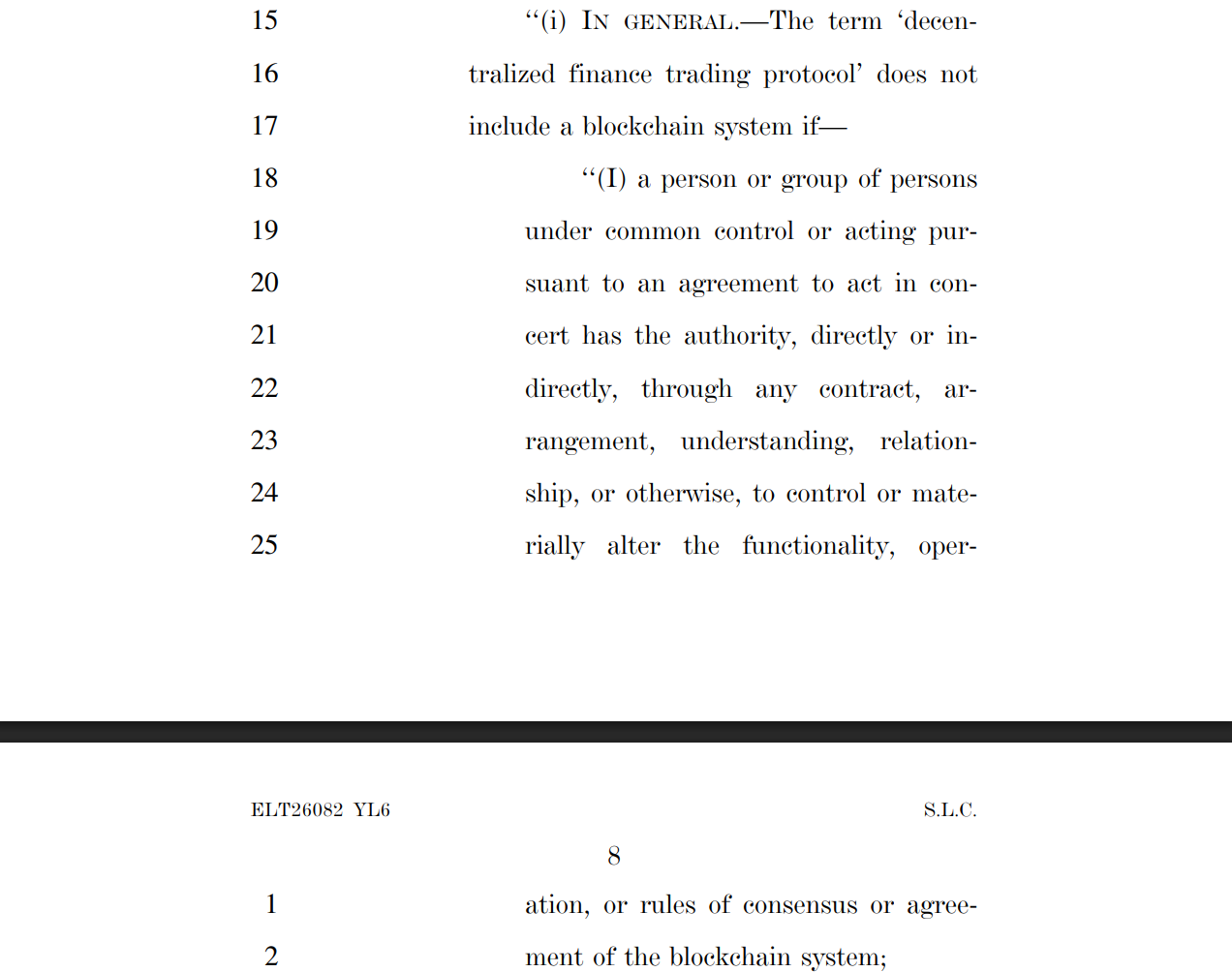
The bill proposes abandoning this overly broad interpretation of "decentralization". A system is not considered decentralized if any person or group of persons has the ability (directly or indirectly, including via contracts or informal arrangements) to control or materially alter the system's functionality, operations, or consensus rules.
The authors are very clear about what matters to them. If there exists an entity that, either at the request of authorities or on its own initiative, can:
- freeze users' funds,
- prevent certain users from accessing the system,
- or change the system's rules,
then that system is not decentralized, and that entity may bear responsibility for how the system operates.
Now try to figure out what share of crypto projects that are currently labeled as decentralized actually do not retain such powers in the hands of developers or owners. You might be surprised by how small that number really is.