


TON’s Core Issue: Building for Metrics, Not Users
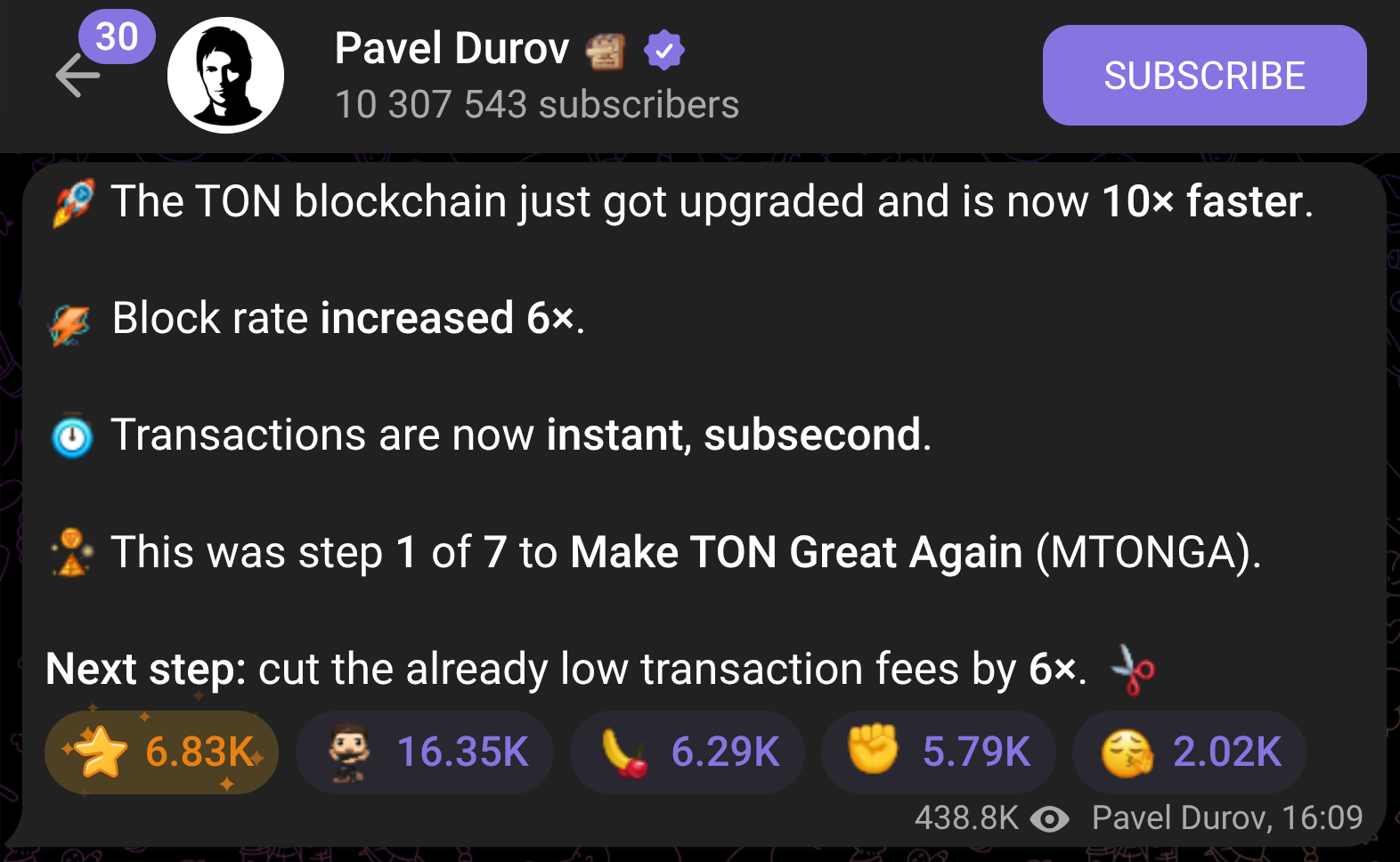
Pavel Durov posted today on his Telegram channel that the TON blockchain has been upgraded and is now 10x faster. How that lines up with the fact that block frequency increased only sixfold, I’m not entirely sure. Is there really anything else that defines blockchain speed besides block time?
But that’s not the main point.
Seeing this odd announcement full of abstract numbers that don’t really explain anything made me realize what might be wrong with TON - and why it hasn’t achieved the same level of adoption as Ethereum or Solana, which it directly competes with.
The problem is that TON has never really focused on solving practical user problems. From the very beginning, back when it was still called Telegram Open Network, the project seemed aimed more at investors than at actual users. And that focus hasn’t really changed.
Who exactly needed a 6x or 10x speed increase? Have you ever personally had issues with transaction speed on TON? Based on the swaps we process at rabbit.io and the feedback our support team receives, transaction speed on TON has never been a concern for users. There are other networks where speed regularly becomes a source of frustration: Monero and Bitcoin, not TON.
The only ones who clearly benefit from this upgrade are validators. The more frequently blocks are produced, the more often validators receive rewards. In other words, staking yields just went up. But for regular users, this doesn’t really change anything.
The same goes for the next upgrade Durov mentioned - a planned sixfold reduction in transaction fees. Why? High fees are a problem on other networks, not on TON. TON fees are already low enough that users don’t complain about them.
If TON wants to achieve real, widespread adoption, it needs to offer something meaningful to users - something they actually care about. Not just abstract metrics, especially when those numbers don’t even seem to add up.