


How Crypto Exchanges Distorted the Meaning of Leverage
In my previous article, I described a crypto portfolio management strategy called CPPI — Constant Proportion Portfolio Insurance. To recap: you set a minimum portfolio value below which you will never fall, and you put the entire amount above that floor to work with leverage. I showed how to use this strategy with rabbit.io.
That probably looked suspicious: how do you use leverage on a swapping service that doesn't lend you money?
The answer lies in a rule that many experienced traders follow: the total risk taken with leverage should never exceed the capital you actually have. In CPPI, that's exactly what happens. Your leveraged position never exceeds your total capital. Your potential losses are capped at the amount you're prepared to lose. And you don't need borrowed funds to make the strategy work.
Just to note — on historical data covering the past couple of years, this simple strategy turned out to be one of the best performers. So if you haven't read my previous article yet, I'd encourage you to check it out: everything is explained there in simple terms.
"Leverage x3" in CPPI is not a loan. It's the ratio between your risky position and your risk budget. You're making ordinary exchanges. No margin account, no funding fees, no liquidation risk.
So why does everyone assume leverage is only available on exchanges that offer margin trading? Because exchanges have made it a central part of their marketing — they position it as their unique service, their competitive edge.
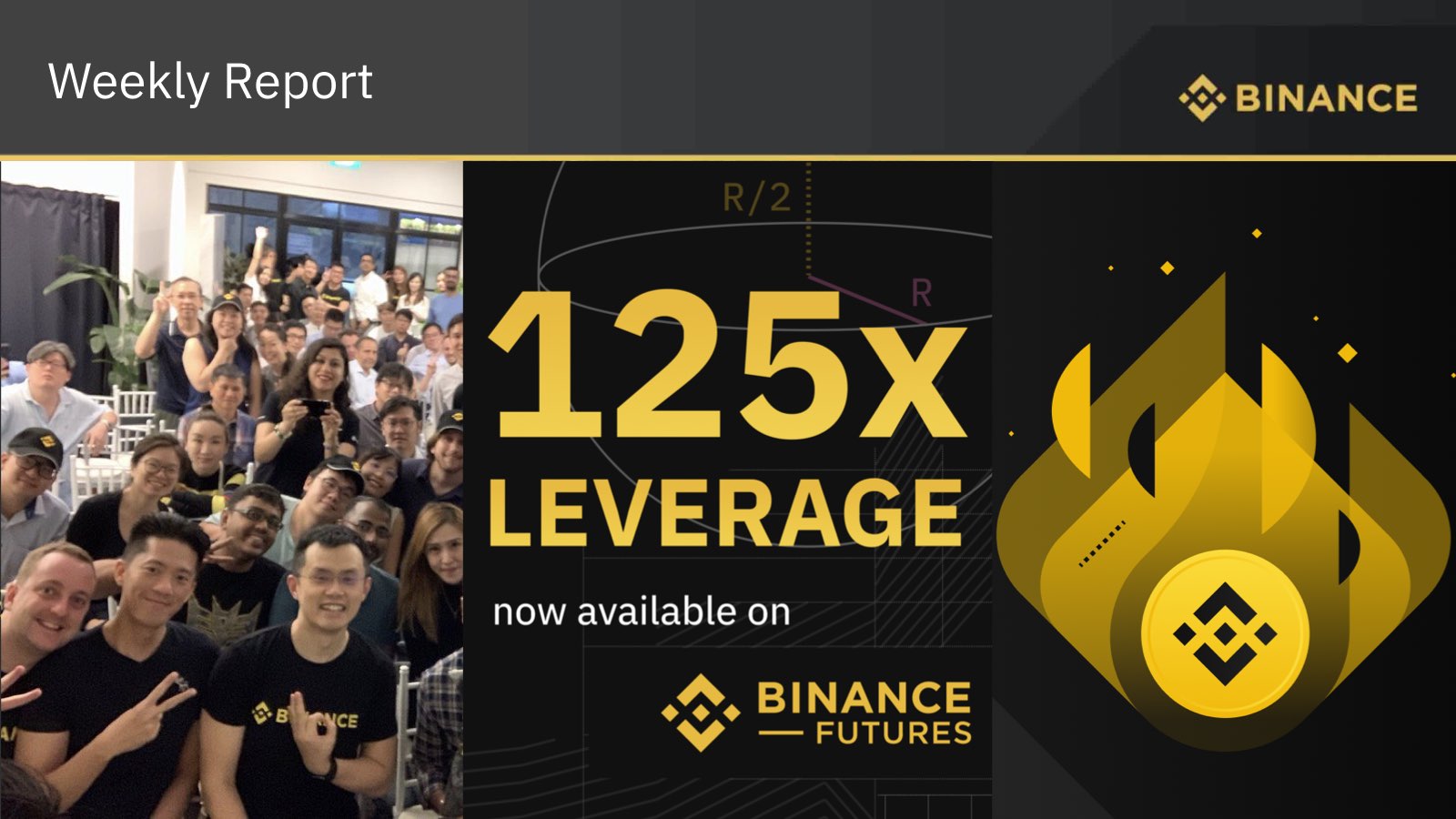
Binance Futures banner from 2019. Source: Binance
In reality, leverage is a fairly standard trading tool. And on crypto exchanges, it's not always something you should see as a benefit.
The Familiar Idea of Leverage: More Profit Through More Risk
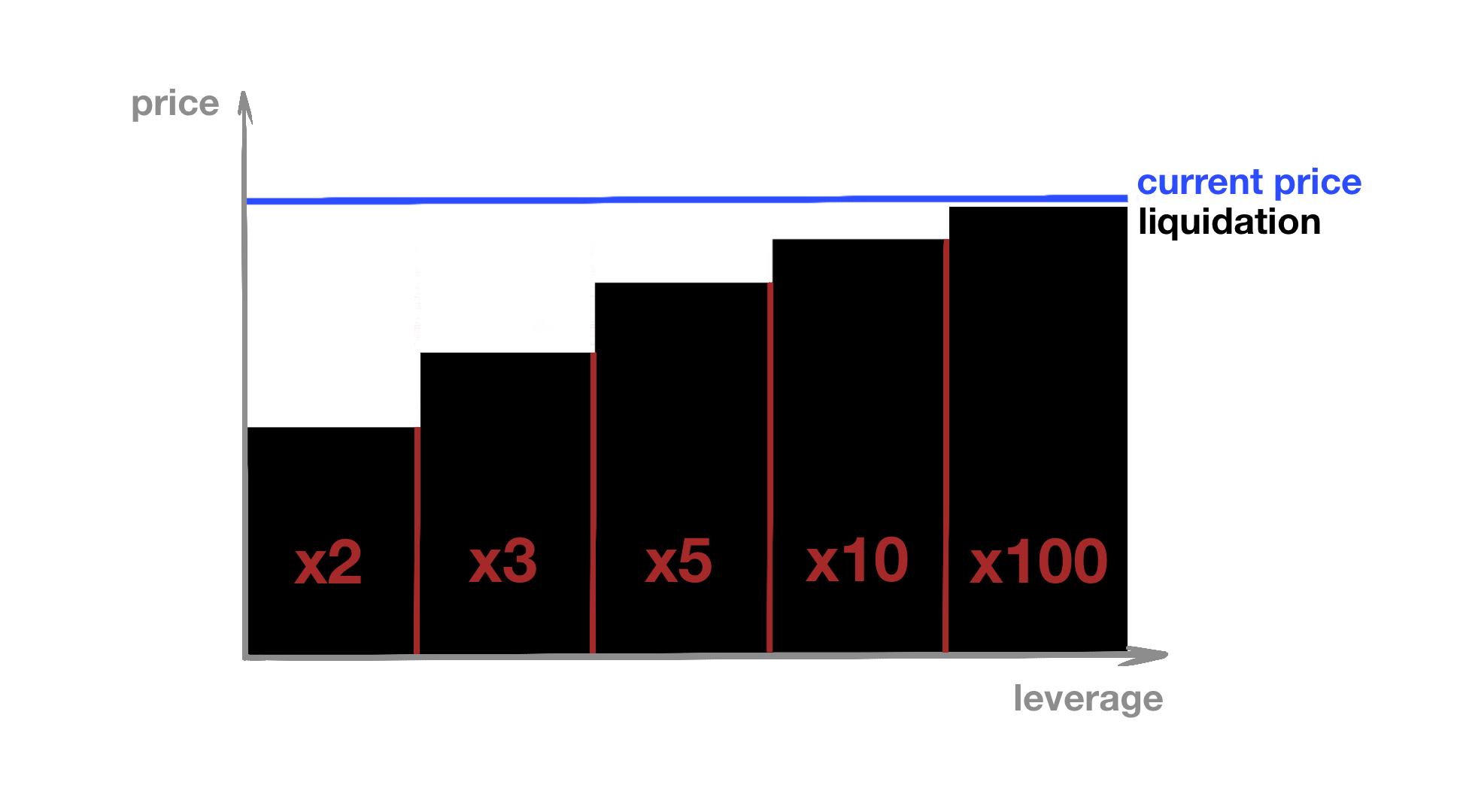
Crypto exchanges have trained us to think of leverage as a way to open a position larger than our capital would normally allow. Have $1,000? With 10x leverage you can trade as if you have $10,000. Have $10,000? With 100x leverage you can get exposure to a million. On screen, this looks like expanded opportunity. In practice, it usually just means expanding the zone in which a price move will wipe you out.
Say Bitcoin is trading at around $75,000. A trader has $75,000. Without leverage, they can buy 1 BTC. If BTC rises 10%, the profit is $7,500. If BTC falls 10%, the loss is $7,500. That's painful, but it doesn't destroy the entire capital.
Now the same trader turns on 10x leverage and opens a position worth 10 BTC. A 10% gain hands them $75,000 in profit. Beautiful. But a 10% drop wipes out their entire capital. With 100x leverage, you don't even need a 10% move to lose everything. The whole point of that kind of leverage is to compress the distance between your entry price and your liquidation price.
And here is where exchanges substitute one meaning of leverage for another. They frame it as a way to increase your potential profit. But the right question isn't how large a position you can open. The right question is how much risk you're prepared to take.
Leverage itself isn't the problem. The problem starts the moment your leveraged risk exceeds the capital you're actually willing to lose.
How Leverage Can Work Differently: Reducing Risk, Not Increasing It
Now I'm going to say something that might sound paradoxical. Leverage is not just a tool for increasing profits by increasing risk. Counterintuitive as it sounds, leverage can be used to reduce risk without reducing potential profit.
Only Risk What You're Prepared to Lose
Suppose you have $75,000 and want to buy one Bitcoin. Without leverage, you deposit all $75,000 onto an exchange. Now imagine: the exchange announces liquidity problems. Or regulators freeze its assets. Or it gets hacked. In February 2025, exactly that happened to Bybit: hackers withdrew around $1.4 billion. Bybit managed to cover the losses — but that's a rare exception. The market's history offers far more common outcomes: Mt. Gox, WEX, QuadrigaCX, LiveCoin, FTX — exchanges that vanished along with their clients' money.
This is counterparty risk: not the risk that the price moves against you, but the risk that the custodian simply doesn't return your money. When you deposit your entire capital onto an exchange, you accept that risk in full.
Now consider a different scenario. You have the same $75,000, but you use 10x leverage. You deposit not $75,000 but only $7,500 — exactly what's needed to hold a 1 BTC position at that leverage. The remaining $67,500 stays in your own wallet, entirely under your control. If the exchange goes bankrupt, you lose $7,500, not $75,000. Your counterparty risk has dropped by a factor of ten.
Meanwhile, your position size is unchanged: one Bitcoin. Your potential profit from a price increase is the same. But the risk tied to trusting a third party with your capital is radically lower. That's what using leverage correctly looks like: you risk a smaller portion of your capital while keeping the same position.
Capping Losses Without a Stop-Loss
There's another benefit that few people think about. If you trade with leverage and only deposit the amount you're willing to lose, you don't need a stop-loss. If the price moves against you and there's not enough margin to maintain the position, it gets closed automatically — by a stop-out. Your loss is capped at your deposit. There's no slippage, which often turns a stop-loss from a protective order into a source of even bigger losses. Most crypto exchanges declare that negative account balances are impossible, which means you can't lose more than you put in.
Diversification Without Sacrifice
The same principle applies to diversification. Instead of putting all $75,000 into one asset, you can open several leveraged positions simultaneously. Buy one Bitcoin with 10x leverage (depositing $7,500) and €50,000 on the forex market with 50x leverage (depositing about $1,100 with your broker). Your overall risk is reduced through diversification, and the remaining $66,000+ stays with you.
Diversification in this example does reduce risk — but it still needs to respect one crucial rule: the total leveraged risk must never exceed the capital you actually have.
If you have $75,000, your leveraged position should not exceed $75,000. Not $750,000, not $7,500,000 — exactly what you have. Leverage is not a tool for opening positions of unimaginable size. It's a tool for getting the same position while depositing only a fraction of your capital on the platform. That's precisely how leverage reduces counterparty risk.
But this understanding is exactly what exchanges don't want you to have.
Why Exchanges Distort the Meaning of Leverage
If using leverage correctly can reduce counterparty risk, why do exchanges almost always sell it as a way to "trade bigger"?
The answer is simple: exchanges earn money from activity.
They benefit from turnover. They benefit when users open the app more often, make more trades, try new products, join tournaments, chase the next volume milestone, and come back to trade — not because their strategy calls for it, but because the interface gives them an incentive.
This is especially visible in promotional campaigns: recurring offers, bonuses for new users, and special conditions tied to new token listings.
Trading Competitions
Take Binance's Trader's Challenge, where users were invited to complete daily trading tasks over seven days. Bybit promotes its annual WSOT tournament as a competition where users must clear a defined trading volume threshold to qualify for rewards — last year that threshold was 50,000 USDT.
From a marketing standpoint, it all seems harmless: trade, compete, complete tasks, get a chance to win. From a risk management standpoint, the picture is very different. A trader might have a strategy that says, "Don't trade today" — while the exchange is saying, "You've got one more task to complete."
Now the trader has a goal that wasn't in their strategy. They're trading not because an opportunity appeared, but because a promotion requires it. They open unnecessary trades, pay fees, take on price risk, and often increase their position size just to hit the volume target faster.
From the outside, it looks like "chasing a bonus." In substance, it's the trader handing the exchange control over their decisions.
New Listings
The same dynamic plays out with listings. The exchange adds a new token, puts up a banner, creates a promo page, and sometimes launches a spot or futures campaign. Binance even has a dedicated page for new listing promotions.
But a rational trader has no obligation to buy a new asset just because it was recently listed. Their capital may already be allocated across assets they understand. Their strategy may have no place for the new token at all. Yet the marketing around a new listing creates a sense of occasion: "something is starting here," "you can get in before everyone else," "there's a reward up for grabs." And the trader takes more leverage to open another position with the listed token.
That's no longer infrastructure for exchanging assets. That's an environment designed to push you into action.
Bonuses That Cost More Than They Give
Another popular tactic is deposit bonuses that can only be unlocked after hitting a certain trading volume. Bitget's Academy notes that the volume required to unlock a bonus can be 10 to 50 times the size of the bonus itself. On Reddit, one trader put it bluntly: "I churned through the volume to unlock my bonus. I ended up losing far more in trades than the bonus was worth."
The bonus, in other words, is bait. You swallow it, and you trade more than you planned. And leverage is what helps you do it.
Gamification: A Casino in Exchange Clothing
Modern crypto exchanges are starting to look less like financial platforms and more like online casinos. Trading is turned into a game: complete tasks, collect points, unlock levels — just like a mobile game, except the stakes are your real money.
Bybit publishes a trader leaderboard ranked by 24-hour P&L. Bitget promotes One-Click Copy Trade: follow "elite traders" and automatically copy their leveraged positions. Similar features exist across other major exchanges.
Academic researchers and industry professionals have documented this clearly. Harvard Business School published a study showing that exchanges have strong incentives to inflate trading volumes in order to attract users and climb the rankings. A Yale University study cited by hundreds of academic papers found that fake trading distorts price, volume, and volatility, eroding investor confidence. According to CEPR and VoxEU, more than 70% of the reported trading volume on unregulated crypto exchanges looks suspicious.
In other words, exchanges don't just push you toward excessive risk. They manufacture an illusion of activity to make you believe that trading large volumes is the norm — and that anything less means you're missing out.
Regulators have noticed, and they've been speaking up. The FCA ran an experiment on "digital engagement practices" and found that push notifications increased the share of trades in risky investments by 8%, and prize draws increased it by 6%. IOSCO warns that online platforms can use gamification techniques to exploit behavioral biases and influence retail investor behavior. ESMA says the same: "Gamification features in trading apps may push retail investors into trading without understanding the risks."
So everyone sees what's happening — and the crypto market seems to have quietly accepted that it's a gambling venue rather than a place for rational exchange.
How Exchanges See the Trader
A rational crypto trader doesn't need an exchange to tell them what to trade today.
They already know which asset they want to acquire. They know which asset they're willing to give up. They choose the moment and the size. If the market isn't offering a good opportunity, they don't trade. If a new token doesn't fit their strategy, they ignore it. If a promotion requires extra turnover, they don't reshape their risk management around the promotion.
But exchange campaigns are often built on the opposite assumption — that users are emotional players rather than rational ones. They can be drawn into a competition, tempted with a volume reward, and made to feel that without acting they're missing out on something.
This is why it matters so much to separate a service from a game:
- A service helps you exchange one asset for another.
- A game keeps you playing.
When someone approaches the market rationally, they don't need the game. They need a straightforward exchange, a transparent rate, minimal noise, and no artificial nudges toward unnecessary trades. That's the context in which rabbit.io makes sense: if your goal isn't to compete for volume or chase exchange tasks, but simply to swap one cryptocurrency for another, you're better served by a tool that doesn't turn the exchange into an attraction.
In Closing
Let's come back, one last time, to the CPPI strategy from the previous article — the one that shows leverage doesn't have to mean borrowed money. On an ordinary swapping service that doesn't extend credit or open futures positions, you can still apply the logic of leverage as a portfolio multiplier.
And that brings us back to the core principle:
- Leverage shouldn't answer the question: "How large a position will the exchange let me open?"
- Leverage should answer the question: "How large a position can I open without my total risk exceeding the capital I'm genuinely prepared to lose?"
Once you accept that rule, it becomes clear why the exchange-industry understanding of leverage is so dangerous. It starts with position size and only then — if at all — considers risk. The rational approach does the opposite: first define the risk, then calculate the allowable position size.
Exchanges benefit from you thinking of leverage as a way to trade bigger.
But in the right hands, leverage can mean exactly the opposite: keep less money on the platform, maintain better control over your risk, and build a portfolio around a loss limit you've chosen in advance.