

What Explains OKB's Perfect Logarithmic Chart?
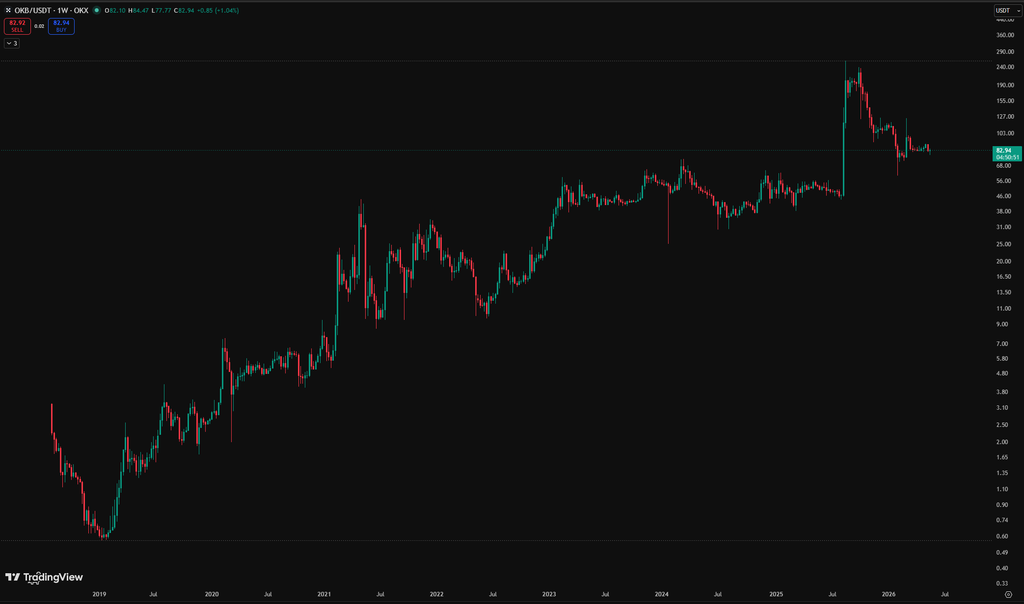
Recently, I came across a thread on the Bitcointalk forum where users were examining the OKB/USD chart on a logarithmic scale and couldn't hide their amazement: seven years of history, and throughout that entire time, the price has moved almost as if it had been drawn with a ruler, staying inside the same ascending channel. Every cycle has produced a new high, while every pullback has found support at a predictable level near the channel's lower boundary. A mesmerizing sight!
I found this interesting for two reasons.
The first reason is that I mentioned OKB in one of my previous articles. It was an article published on August 10, 2025, about crypto assets whose prices reached new all-time highs during the current cycle. At the time, OKB was just one line in a list of exchange tokens. I did not take it particularly seriously. I barely even noticed that within two weeks of the article being published, OKB's price had jumped more than fivefold. Now I wanted to understand how I managed to overlook such a gem.
The second reason is that OKB used to be available for exchange on our website, rabbit.io. But just as I never paid much attention to it, our customers were not particularly interested in it either. Unlike other exchange tokens - BNB, WBT, and BGB - which rabbit.io users trade very actively, OKB remained largely ignored. Eventually, we removed the token from our website to avoid cluttering the list and to make it easier for customers to find the assets they actually needed.
It is difficult for me to believe that neither I nor our users paid attention to a token that has, in fact, grown organically throughout its entire history. Yet users on Bitcointalk have noticed exactly the same thing: OKB has been steadily rising while remaining almost invisible to everyone. The chart shows seven years of continuous, methodical, almost geometrically precise growth that survived the first crypto winter, the collapse of numerous crypto projects in 2022, the pandemic, and major macroeconomic shocks. And all of this happened below the radar of crypto enthusiasts searching for reliable assets to invest in.
I decided to investigate what exactly has shaped this seemingly perfect chart.
OKB's Scarcity: Just 21 Million Tokens
Most people like exchange tokens because of their utility: fee discounts, access to IEOs (initial exchange offerings), and other perks. Even if you cannot sell the token for more than you paid, at least you can still use it.
But OKB's utility always seemed rather limited to me: the discounts it provides are relatively minor compared with some other exchange tokens, and when the exchange - OKX, still called OKEx back then - first issued it, I honestly could not see a compelling reason for users to hold it. I quickly forgot about the token.
Other market participants apparently did not see much value in OKB immediately after launch either. Its price continued falling until the spring of 2019. But in May 2019, the token-burning program began. Every quarter, OKX used 30% of the revenue generated from spot trading on the exchange to buy OKB on the open market and then send those tokens to a burn address.
Does that model sound familiar? It was later popularized by the exchange Hyperliquid, which used a similar mechanism to attract investors to its HYPE token. Hyperliquid managed to turn this idea into genuine hype, probably helped by the enormous share of fees allocated to buybacks: 99%. OKX, meanwhile, quietly bought and burned tokens, creating steady and consistent growth without attracting much attention.
By June 2025, 28 rounds of burns had taken place, and according to OKX, a total of 213.743 million OKB had been destroyed. For six years, the market watched the same ritual unfold: supply kept shrinking. And when supply decreases while demand remains stable, even without increasing, the price of an asset tends to rise. That is exactly what we see on the chart.
On August 13, 2025, this ritual came to an end. OKX announced a one-time burn of another 65.257 million OKB accumulated in treasury reserves, along with a contract upgrade that fixed the total supply at 21 million tokens and removed the burn function.
News reports began citing a figure of 279 million destroyed OKB with a market value exceeding $26 billion. This was one of the factors behind the sharp fivefold increase in the price. Technically, the headlines were correct: 213.743 million tokens from previous burns plus 65.257 million more added up to 279 million, while the contract's total supply fell from 300 million to 21 million. But the exchange itself spent almost nothing on this final burn, because the overwhelming majority of the destroyed tokens were already sitting in treasury reserves.
Mid-August 2025 was one of those rare periods when OKB briefly became a hot topic. The sudden attention overheated the price. At its peak, it reached $258.6 before gradually declining. But even now, OKB remains more expensive than it was before the final burn: $80 compared with $44.
The deflationary phase of OKB's history is over, but deflation alone could not have been the only factor behind its price growth. A token can be scarce, but if nobody uses it, it is dead. As Katie Martin from the Financial Times once put it, "my teeth are scarce too, but they are not worth billions of dollars."

Katie Martin smiling - her teeth are not worth that much
OKX's June Proof of Reserves report shows that 19.862 million OKB were held in customer accounts. With a total supply of 21 million, that is almost 95% of all existing tokens. Does this mean that practically nobody actually uses these tokens and everyone simply keeps them on the exchange?
Perhaps this fact also helps explain the price. Nominally, 21 million OKB exist, but if someone tried to buy them outside OKX, they would discover that the available supply there is roughly 20 times smaller. Any serious demand would immediately run into the fact that almost nothing can be purchased at the current price.
It seems that scarcity really is one of the main reasons behind the token's high valuation. When Katie Martin talked about the scarcity of her own teeth, her point was that she could not understand Bitcoin's valuation. But Bitcoin is used by millions of people, whereas almost the entire OKB supply is held on a single exchange. Her criticism actually applies to OKB to a much greater extent. OKB's current market capitalization of $1.69 billion, which keeps the token in CoinMarketCap's top 50, appears artificially inflated.
I would go even further. If users, for whatever reason, were to withdraw their tokens from OKX en masse, the resulting increase in available supply could be devastating for OKB's price. And history already has examples of large-scale withdrawals from this exchange.
Does OKB Serve Any Purpose Outside OKX?
For a long time, OKB was described as an exchange coupon - a token that provided access to OKX products and privileges. But today, OKX presents OKB primarily as the gas token and core asset of X Layer, the blockchain created by the company.
In 2025, the X Layer network was integrated with the exchange, the wallet, and OKX Pay. At the same time, OKX announced the shutdown of OKTChain, a project that competed with X Layer, and the conversion of OKT into OKB. All of this was intended to stimulate on-chain activity on X Layer and increase demand for OKB.
However, the average transaction on X Layer costs only around $0.00003 (0.0000004 OKB). According to DefiLlama, the network generates less than $200 in fees per day. This is not a revenue stream capable of justifying OKB's market capitalization of approximately $1.69 billion.
Therefore, the market is not paying for current demand for gas. It is paying for expectations about the future.
In May 2026, those expectations began to take shape. OKX introduced Exchange OS - an infrastructure platform that allows developers and organizations to launch their own spot markets, perpetual futures markets, and event-outcome markets on X Layer.
The most interesting detail is hidden in the technical documentation: before launching a venue, an operator must stake OKB in a dedicated contract. Here, the token stops being merely gas and starts resembling a fee for a building permit. This could become a much stronger source of demand than tiny gas payments, because it creates demand for locking tokens.
But do you know how OKB's price reacted after the Exchange OS announcement? According to CoinGecko, this is what happened:
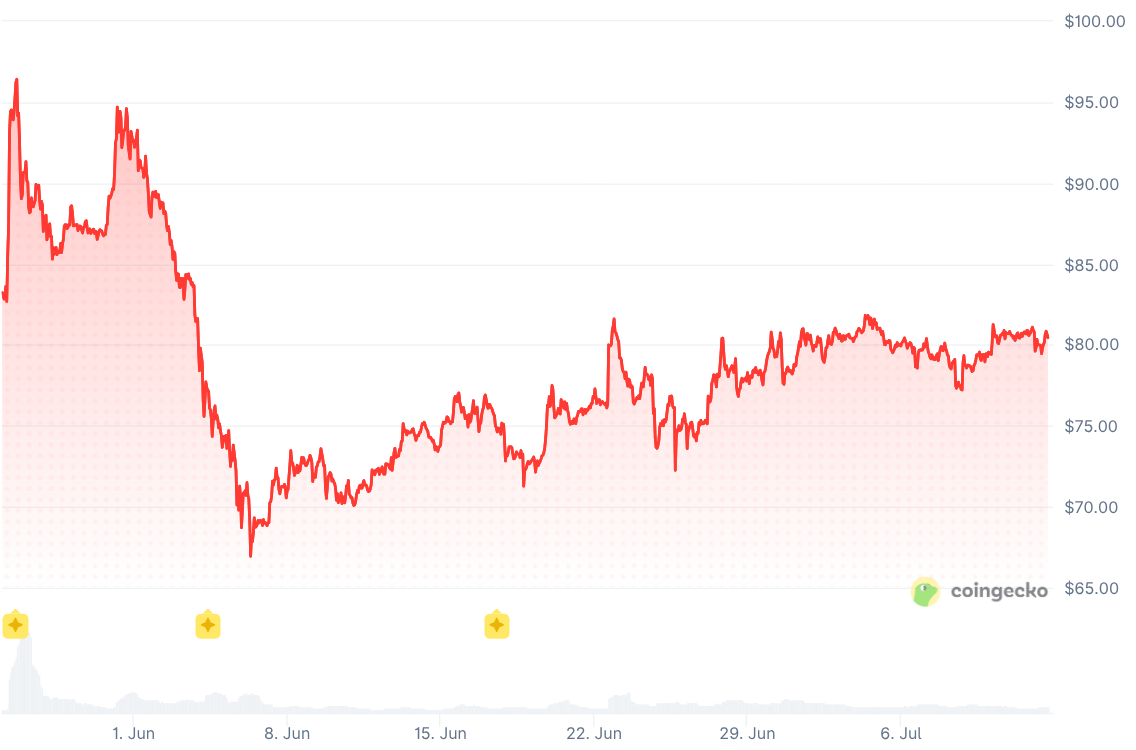
For now, Exchange OS is only a blueprint for possible future demand, not evidence of mass adoption. The rollout is happening gradually, and the first use case mentioned in the announcement was a simulated World Cup prediction market without any real monetary value attached.
It remains unclear whether independent operators will actually appear who are willing to lock up OKB in order to launch markets specifically on this blockchain. To be honest, I do not see much reason why they would.
OKB's dependence on OKX is also illustrated by another episode. In March 2026, Intercontinental Exchange, the parent company of the New York Stock Exchange, acquired a minority stake in OKX and received a seat on its board of directors. The market interpreted this as a sign that the exchange was gaining legitimacy, and OKB's price immediately jumped by 25%.
But the effect did not last. Within three weeks, the price had returned almost exactly to where it had been before the spike. This is clearly visible on the CoinMarketCap chart.
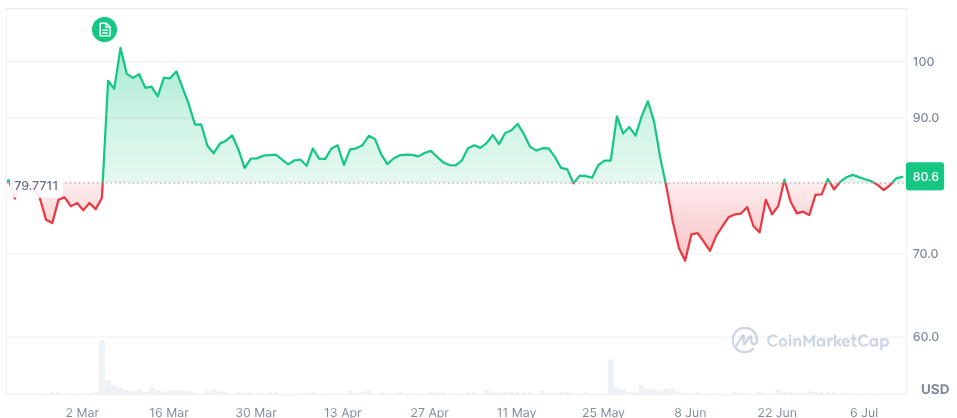
And this makes sense. ICE invested capital in OKX, not in OKB. The deal itself gave token holders nothing: not even a share of the exchange's profits is now directed toward token buybacks and burns.
OKB holders can benefit from the exchange's success only indirectly: if this expansion brings users to products where the token itself is required.
Why Hasn't the Ascending Channel Broken Yet?
After studying OKB's history, I am left with the impression that the reason behind its steady growth may be precisely the fact that so few people pay attention to it.
Yes, I identified several objective factors that could support the price:
- years of token burns that steadily reduced the supply;
- the 21 million cap, which eliminated uncertainty about future issuance and created a parallel between OKB and BTC;
- the integration of X Layer into OKX applications, the shutdown of OKTChain, and the launch of Exchange OS, all of which create opportunities for expanding the use of OKB.
But none of these factors individually - and not even all of them combined - fully explain the perfect geometry of the chart.
The flawless staircase pattern visible on OKB's chart looks like a market anomaly that has persisted for seven years. It can only be maintained because hardly anyone notices it. Whenever attention turns toward the token, sharp spikes occur, and then everything returns back to the previous trajectory.
Given that almost the entire token supply is concentrated on a single exchange, making independent trading at any serious scale difficult, the possibility that this attractive chart is being artificially maintained cannot be ruled out.
But perhaps I have missed something?
Maybe it was only rabbit.io customers who had no interest in this token? Maybe demand across the broader market has actually been growing steadily along with the price? Maybe it is still growing today?
What do you know about the reasons behind OKB's growth? Share your thoughts in the comments!