


DIEM: The Token That Gives You $1 a Day for AI Access
In my articles, I usually focus on the crypto assets you can swap on rabbit.io. But today's piece is about a token we don't list: DIEM, issued by Venice.ai. I just can't walk past this one, because there's genuinely a lot to talk about.
DIEM has a unique usage model that makes it valuable to anyone who needs access to AI resources. You buy one DIEM token, lock it up — and every day you receive $1 in Venice credits that you can spend on API requests to top models available on Venice.ai (including Claude Opus 4.7, ChatGPT 5.5, Qwen 3.6 uncensored, and other cutting-edge models that get added regularly as they come out). Want $2 a day? Lock two DIEM. Want $10? Lock ten. When you no longer need access, you simply unlock the tokens and sell them on the market.
Think of DIEM as a discount coupon that entitles you to a daily discount on AI access for as long as it stays locked in your wallet. Each token gives you a $1-per-day discount, and that coupon can cover up to 100% of the compute you consume. If you have one coupon but need more than a dollar a day, you pay the difference out of pocket. If you stay within the $1 limit, the coupon covers everything.
A token like this has clear, tangible consumer value on its own — and that's an extreme rarity among crypto tokens. The closest analogy might be exchange tokens that offer trading fee discounts on the platforms that issued them. But not everyone uses a crypto exchange, and not everyone needs that kind of discount. AI, on the other hand, is working its way deeper into our daily lives, and soon it will be as routine a line item in everyone's budget as internet access once became. A discount on AI may soon be useful to just about anyone — especially when it's a discount that works not just on one vendor's models, but across an impressive list of popular ones.
In short, DIEM looks almost too good to be true. So I decided to dig in and figure out where the issuer's promises hold up — and where it might be smoke and mirrors.
What Is Venice.ai
Venice.ai is a privacy-focused, less censored alternative to the mainstream AI platforms. It was founded by Erik Voorhees — the same person who created ShapeShift, one of the first non-custodial crypto exchanges. He's someone with a real track record and reputation in the crypto industry.
Through Venice, you can work with a variety of models: open-source uncensored models running on Venice's own servers, as well as major proprietary models accessed through an aggregator interface.
These are two distinct modes:
- For open-source models, Venice emphasizes privacy: the company claims it does not log your chats or store conversation history on its servers the way traditional centralized AI services do.
- For models like Claude, GPT, Gemini, or Grok, Venice acts more as a proxy — the external provider sees a request from Venice rather than from you directly. This improves anonymity but does not mean no one besides you ever sees the request.
The difference sounds significant, but not so much that all Venice users restrict themselves to models running on Venice's own servers. On the contrary, many people use Venice precisely as a gateway to third-party models. It's convenient: pay one provider and get access to the latest offerings from any vendor.
And it's within this setup that DIEM gives you $1 a day across all models.
How Much Does DIEM Cost
I first noticed DIEM in early January 2026. Back then you could buy it for $250. At a usage rate of $1 a day, the payback period was exactly 250 days — a little over eight months. After that, in theory, it would be a pure daily dollar of credits, forever.
I walked right past it. The reason was simple: I had no urgent need for a discount on AI access. Of course, rabbit.io uses AI — for instance, AI translates every article on our blog into seven languages (and it will translate this one too, so if you'd rather read it in a different language, head over to our blog and find it there). But that kind of usage doesn't involve enormous costs, so the idea of "discount coupons" didn't feel relevant at the time.
I thought back then that the token was interesting, but its time hadn't come yet. The average user wasn't spending a dollar a day on AI. And new AI services kept popping up, many of them offering a free trial week, a free month, or $10–20 in credits — so you could just hop between them and pay nothing at all.
But then OpenClaw, Hermes Agent, and other tools appeared — tools that turn language models from an assistant you use now and then into always-on infrastructure that demands stable API access. In other words, paid access every single day — exactly the kind of thing the DIEM token is designed to help with.
I looked at the DIEM price again and saw: $1,656.97. That was the all-time high, set on May 9, 2026. The payback period had stretched to four and a half years.
The price pulled back slightly after that, but today it's heading for fresh highs once again. The market keeps buying.
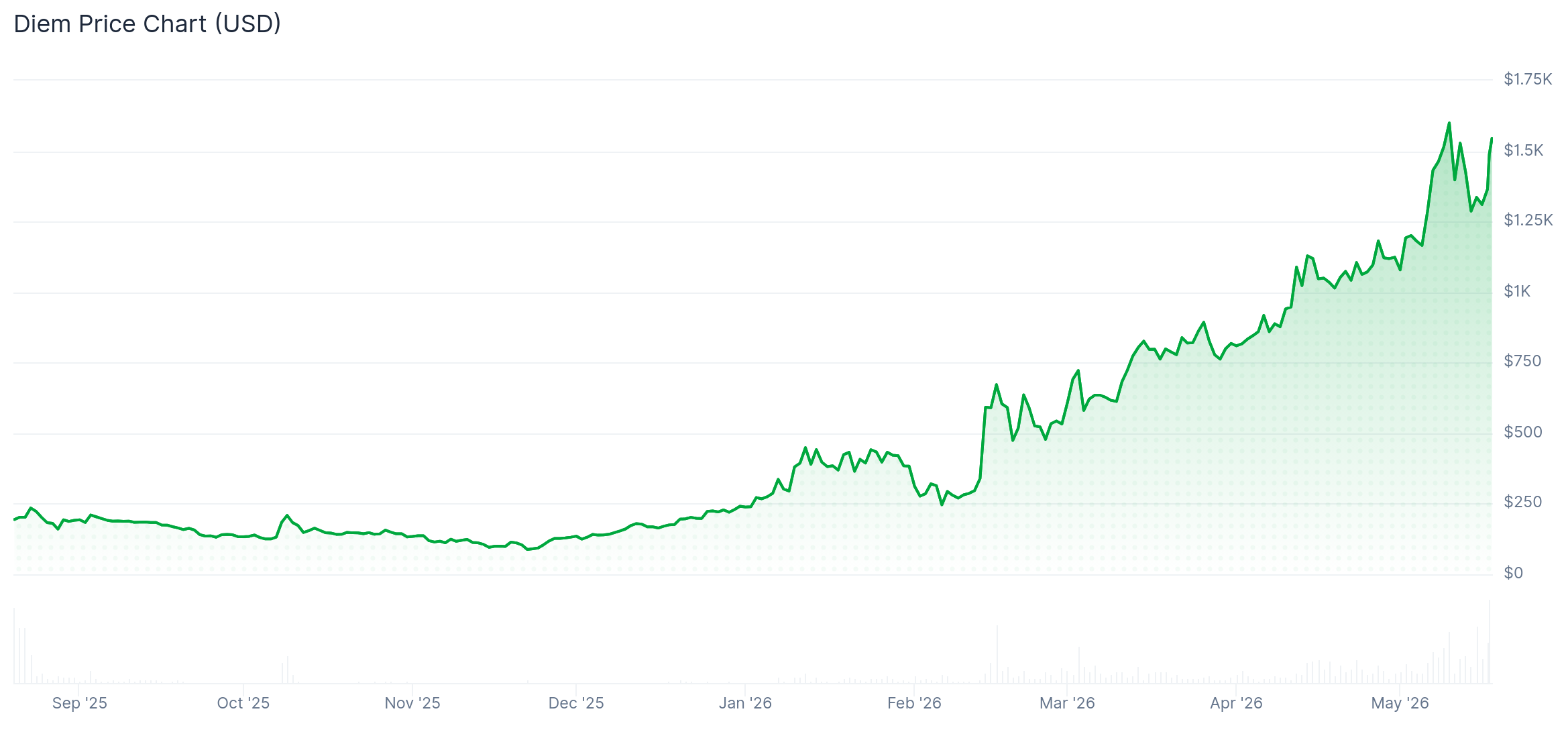
DIEM price chart. Source - Coingecko
Why the DIEM Price Is Rising
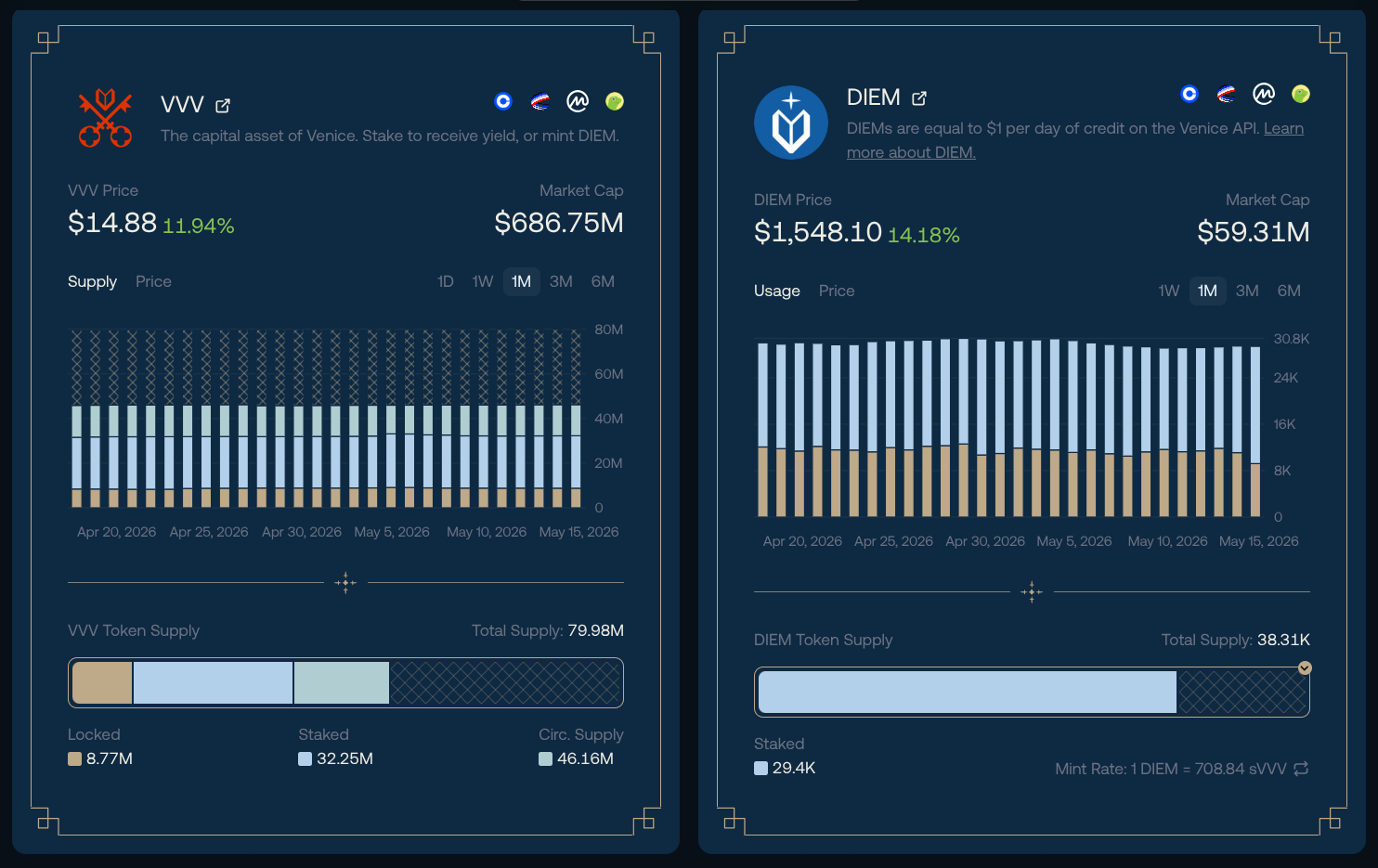
New DIEM tokens can't simply be printed out of thin air. They can only be created through Venice's other token, VVV. Here's how it works: a VVV holder stakes their tokens, receives staking tokens called sVVV in return, and can then lock those sVVV to mint new DIEM. The higher the total DIEM supply, the more expensive it gets to mint new ones. The very first DIEMs could be minted at a rate of 90 sVVV per 1 DIEM. The current mint rate is 708.84 sVVV to produce a single DIEM token.
Screenshot from Venice.ai
With VVV trading at around $14.49, the cost to mint one DIEM comes to over $10,000. Meanwhile, DIEM's market price hovers around $1,500. Minting a new DIEM under these conditions is utterly pointless. It's far cheaper to buy one that already exists.
And that's a powerful bullish argument. If demand for API-based AI access is growing while no new DIEM are being created, the price could keep searching for a new equilibrium far above current levels.
An important caveat is in order here. Venice could adjust the mint rate to make minting new tokens more attractive. But why would it? After all, every DIEM represents Venice's obligation to deliver $1 worth of AI compute resources per day.
So DIEM's supply is constrained not mathematically but economically. Even now, with 38,310 DIEM issued according to Basescan, Venice must be ready to deliver AI resources worth $38,310 per day, every single day.
Of course, claims against these obligations are far from being exercised in full. Not every token holder locks their DIEM to gain AI access; many simply trade them. But given the rising demand for AI, Venice's strategists must understand that all of these claims will very likely be exercised sooner or later.
Where Does Venice Get the Money
Source one: paid subscriptions. Venice offers three tiers: Pro at $18 a month, Pro+ at $68, and Max at $200. According to Voorhees himself, as cited by PANews, by March 2026 the platform had roughly 55,000 paying subscribers and monthly revenue of about $835,000, growing at approximately 15% per month.
But not all of that money goes to the company. Under the platform's rules, a portion of revenue must be used to buy back and burn VVV tokens. From each paid Pro subscription, $2 goes toward that purpose; from each Pro+, $5; from each Max, $10.
Source two: direct API payments. Users who exceed their subscription limits pay additionally for each request. Venice keeps a cut of those payments: based on publicly listed prices, the markup on GPT-5.5 is roughly 25% above OpenAI's rates, and on Claude Opus it's about 20%. On open-source models, where Venice controls its own GPU infrastructure, the margin is higher.
Source three: VVV token staking. The company holds a share of the VVV token supply and earns yield from staking it. That income is paid out in new VVV tokens rather than cash, but those tokens are reasonably liquid, especially given the buyback-and-burn program.
On the whole, however, the daily credits for DIEM holders are subsidized primarily by Venice's paying users — those who purchase subscriptions and pay for API access directly.
The math here isn't exactly reassuring. Venice's potential obligations — $38,310 per day — work out to roughly $1,150,000 per month. Against a reported revenue of $835,000, that figure doesn't look comfortable.
There are, of course, two important mitigating factors. First, one dollar of Venice Credits costs Venice less than one real dollar in expenses — and on open-source models, far less. Second, plenty of holders surely don't use their full daily allowance.
But the core problem doesn't go away: as demand for AI grows, more and more DIEM holders will want to use every last credit. And precisely when DIEM becomes most useful is when Venice bears the heaviest load. In other words, the very usefulness of the token that first impressed me works against its issuer.
It may actually be in Venice's interest to reduce the real-world consumer value of DIEM. And they have the levers to do it.
What You're Actually Buying
DIEM does not give you "eternal access to Claude and ChatGPT." It gives you a perpetual stream of Venice Credits with a face value of one dollar per day. Venice states plainly in its documentation that the model lineup may change, and that any model can be discontinued with 30 days' prior notice. The platform's change log already shows such cases: for example, the company has removed GLM 4.6, Qwen Coder, DeepSeek Coder, and Kimi K2 Thinking.
There's another point in Venice's terms of service worth knowing: Venice Credits have no monetary value and cannot be redeemed for cash. In other words, the credits you get by locking DIEM can only be spent on whatever "goods" happen to be in stock at the "store" on any given day, and at whatever prices the "store" has set.
Today, Venice's pricing is more or less competitive: there is a markup relative to paying OpenAI or Anthropic directly, but it's fair considering that Venice lets you switch easily between models from different vendors. However, no one guarantees that pricing will remain reasonable forever. It's entirely possible that on some future day, the $1 you get on Venice will buy the same volume of compute that costs just $0.01 elsewhere.
Is DIEM worth buying?
I started out by comparing DIEM to a discount coupon, but after analyzing the full picture, I've come to the conclusion that DIEM can also be compared to a futures contract on compute resources available through Venice.
Today, that futures contract costs about $1,500. You put that money down as a prepayment for resources that will be delivered to you in the future. But as with any other futures contract, no one can know in advance whether the trade will turn out to be a good one.
If Venice's customer base keeps growing at its current pace, 15% monthly revenue growth translates to roughly a fivefold increase in a year. That would mean revenue comfortably covering all DIEM obligations with room to spare. In that case, you'd not only recoup your investment within 4–5 years but would almost certainly come out well ahead thanks to an inevitable rise in the DIEM price. (Inevitable in this scenario because the risk of Venice failing to meet its obligations to token holders would essentially be eliminated, making the token even more attractive than it is now.)
But if the burden of obligations to DIEM holders exceeds Venice's ability to pay, or if a major provider like OpenAI or Anthropic cuts off Venice's API access, or if regulators force Venice to shut down its "uncensored AI," or if competitors offer cheaper privacy solutions — then Venice will be forced to dilute the real substance behind Venice Credits, DIEM tokens will become far less appealing than they are now, the price will drop, and your only option will be to sell at a loss.
So before buying DIEM, I'd ask myself two questions:
- Am I willing to use AI access worth $1 a day, even if the available models are no longer as cutting-edge as they are today?
- Am I willing to keep using the same company's services for four and a half years or more, even if more attractive options appear on the market?
If the answer to both is "yes," then this futures contract on Venice's services is a worthwhile investment for me. But if even one answer is "no," that's reason enough to think twice about buying.
My Question to You
If DIEM showed up on rabbit.io and was available to swap at the best possible rates, like every other cryptocurrency you can exchange with us - would you come to us for this token? Or, on the contrary, would you swap it for something else?