


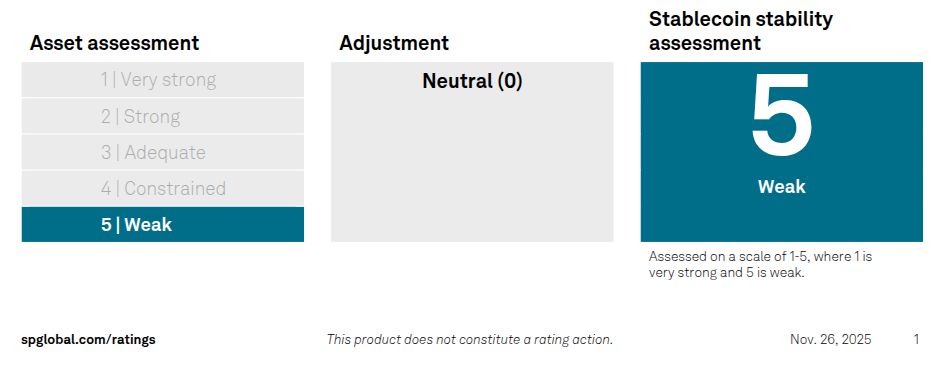
Why S&P Called USDT "Weak" - And Why That’s Not the Main Issue
The recent S&P Global downgrade of USDT’s stability rating feels like theater more than analysis.
S&P Global announced that USDT, issued by Tether, has been assigned the lowest possible rank - 5 (weak).
- But it wasn’t downgraded because Tether arbitrarily shuts down support for entire blockchains and then later states that redemption of remaining tokens on those chains will no longer be honored. (And if a holder is in a coma, in prison, or simply lacks access to private keys for a while - their funds are gone.)
- And it wasn’t downgraded because Tether is legally obligated to redeem USDT only for the exact entities that originally provided the collateral for issuance. (Meaning, if that company has since been dissolved and has no successor, current holders have no formal right to redeem their tokens for dollars.)
- Instead, the primary reason given is the increased presence of volatile assets - such as BTC and gold - in Tether’s reserves.
This allowed Tether’s CEO to frame the company as a hero. He posted that S&P Global is simply upset because Tether exposes how broken the traditional financial system is. Conveniently, this shifts the discussion away from real concerns.
It’s unclear why S&P Global even decided to issue “stablecoin stability ratings” in the first place. The very concept sounds like an April Fools' joke.
Now we get to watch how “unstable” USDT will be while it carries this newly assigned bottom-tier rank.