


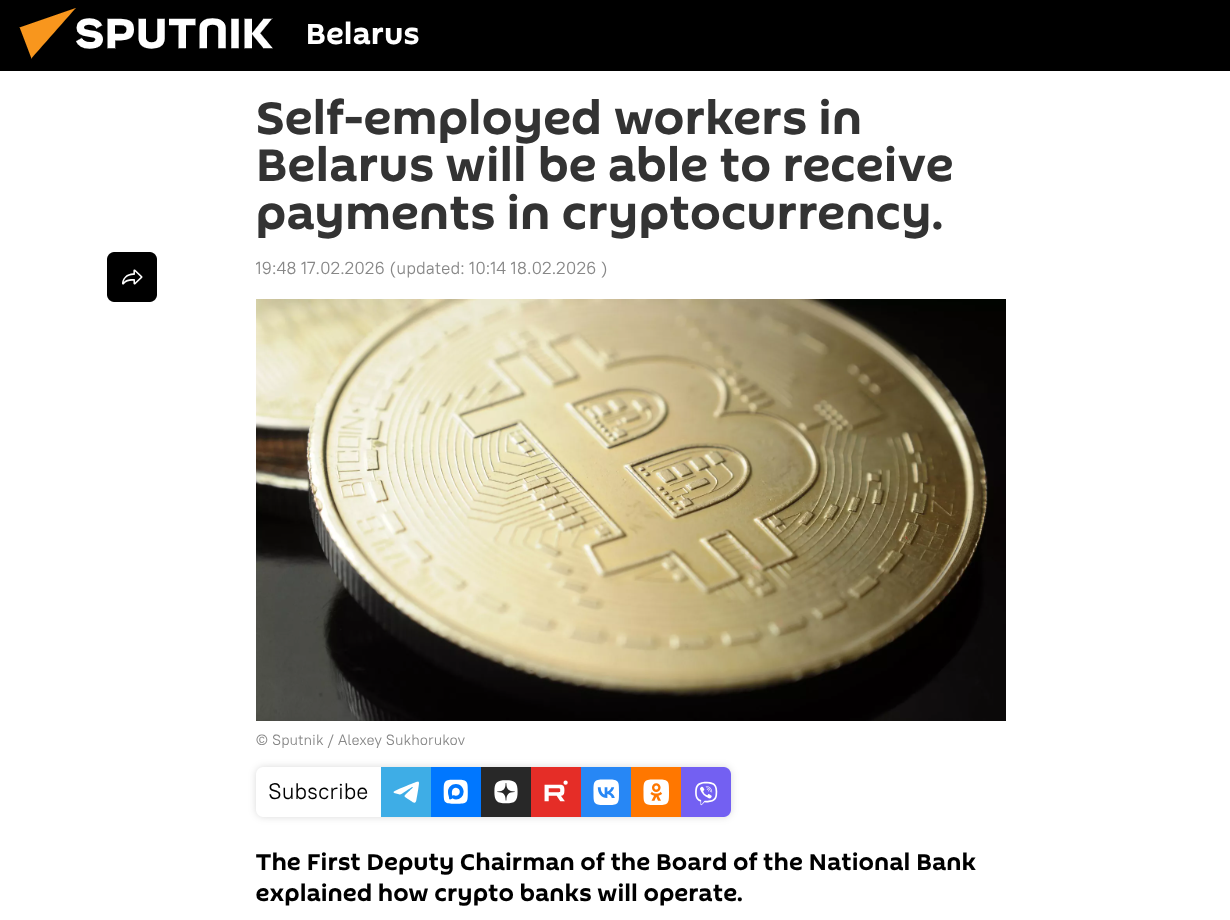
The Return of Crypto Payments in Belarus - On the Bank’s Terms
In Belarus, the Deputy Governor of the National Bank has announced that in the near future, self-employed individuals - meaning entrepreneurs and freelancers - will be allowed to receive payment for their services in cryptocurrency.
At first glance, it sounds progressive. Even more ambitious than El Salvador, where similar rules apply only to Bitcoin, not to other cryptocurrencies.
But let’s take a closer look at what this actually means.
Back in 2017, Belarus introduced crypto legislation that was arguably the most liberal in the world at the time. You could do almost anything with cryptocurrencies, and most transactions were tax-free.
Then, in 2021, the rules changed. A ban was introduced on entrepreneurial activity involving the receipt of cryptocurrency. In practice, this meant that business owners were no longer allowed to systematically receive crypto as payment for their services.
Now the National Bank says this right will be restored for entrepreneurs and freelancers.
There is, however, a catch.
Such payments will have to go through specially created “crypto banks.” Which means this: the entrepreneur does the work - and the bank receives the cryptocurrency instead. The entrepreneur will not actually have any crypto. What they will have is a claim against the bank. A promise on paper. And there is no certainty that the bank will satisfy that claimon their terms, on their timeline, or at all.
I am confident that central banks in other countries will be tempted to adopt the same model.
Don’t be misled. This is not the right to receive cryptocurrency. This is a substitute.
Receiving cryptocurrency means that the funds are sent directly to a wallet under your full control - just like when you exchange assets on rabbit.io.