


Yearn’s Hack Was Reversed. Now What?
Yearn Finance was hacked - and no one expected it. For years it has been seen as one of the benchmark protocols for yield farming. It stood at the frontline of the DeFi boom in 2020, and even today, according to Coingecko, its governance token remains the most expensive on the market.
But history and reputation don’t guarantee invulnerability. The protocol turned out to be less secure than its status suggested: roughly $3 million worth of liquid staking tokens were drained.
And then the story took an unexpected turn. Very quickly, Yearn Finance announced that, with the help of two teams - Plume and Dinero - they managed to recover a large portion of the stolen funds (around $2.3 million).
Stop right there. Recovered? Did they track down the hacker and convince them to give the money back? Except… Plume and Dinero don’t exactly specialize in crypto forensics. Their focus is tokenization: real-world asset tokens and liquid staking tokens. So how could they possibly help?
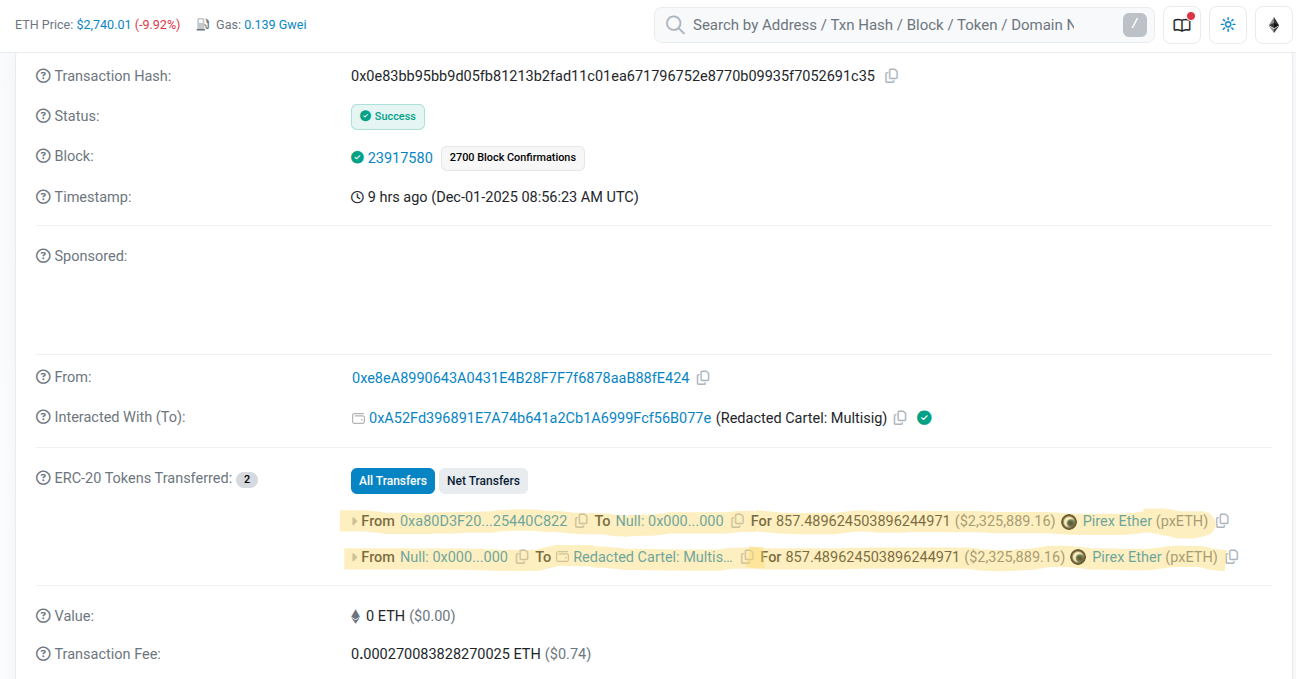
Here’s the answer. In their announcement, Yearn links to an Etherscan transaction showing how the “recovery” happened. Tokens held on one address were burned - and an equivalent amount was freshly minted and sent to a different address.
Just like that. No court ruling, no formal investigation - tokens were effectively taken from the attacker and reassigned elsewhere.
This runs counter to the classic ethos of crypto - neutrality, immutability, no one able to reverse a transaction. But does the community truly stand by those principles today? I’m sure many everyday users are secretly relieved that a “restore everything” button exists somewhere in the system.
Honestly, I’ve been waiting for someone to dare to press it. Now the real test begins: how consistent will Plume and Dinero be? Next time someone asks to reverse ownership - take tokens from one user and give them to another - will they do it again? If yes, they may carve out a very real niche in the industry. A niche that, until now, has been practically vacant.
Ethereum Foundation tried something similar once - back in 2016. It lasted exactly one time. No one dared repeat it.