


Convenience Comes at a Cost: The Problem With Crypto Debit Cards
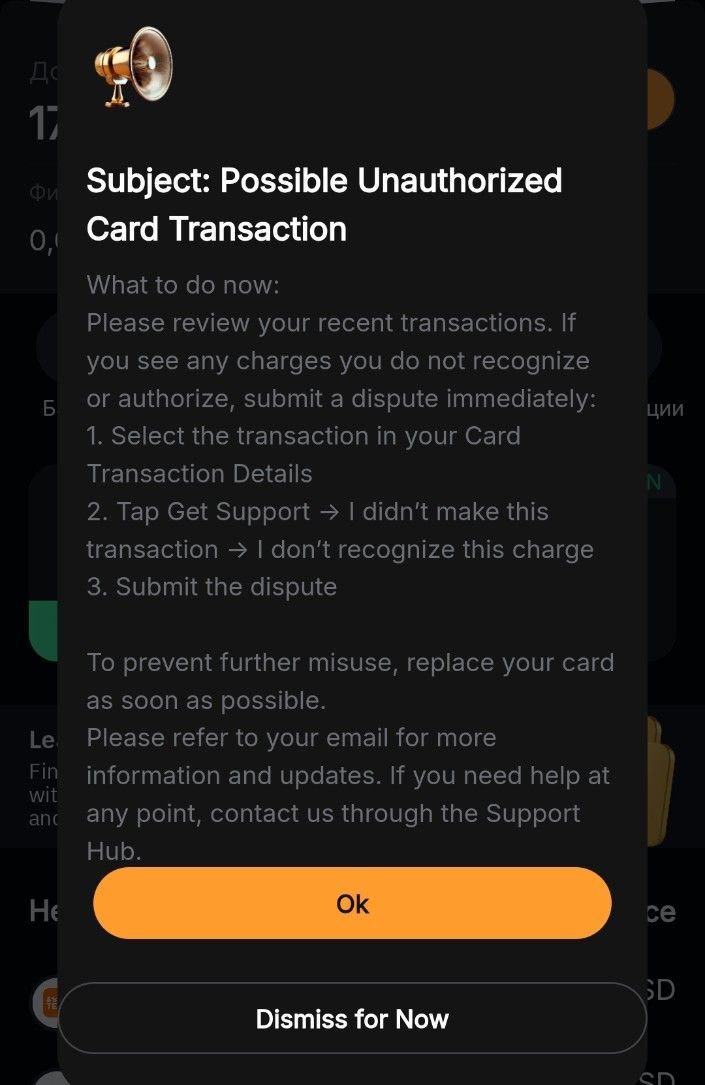
Bybit users have reported unauthorized transactions on their debit cards.
Let me first clarify what this is about. Bybit allows its customers to issue a debit card linked directly to their exchange balance, making it possible to spend cryptocurrency in regular stores. On the surface, this looks extremely convenient. Traders do not need to manually convert crypto into fiat - the conversion happens automatically at the moment of payment. From the user's perspective, they pay in crypto, while the merchant receives fiat. Sounds like a perfect solution, right?
However, it turns out that this system contains a vulnerability that allowed attackers to use other people's cards for payments. Based on user reports and chat discussions, most - if not all - of the unauthorized transactions were conducted in Brazilian reals. Some of them were tiny and nearly unnoticeable, just a few cents, while others were much larger, reaching up to 1,000 BRL in unauthorized charges.
Bybit has advised affected users to reissue their cards. As for additional precautions, one possible approach is to keep the card frozen by default and unfreeze it only shortly before making a purchase.
All of this once again highlights that crypto debit cards only appear to simplify the user experience. In reality, they make it more complex.
Cryptocurrencies were originally designed to enable seamless, direct payments without intermediaries such as fiat gateways and card networks. But, unfortunately, the vast majority of merchants worldwide still do not accept cryptocurrencies. This forces users and service providers to build increasingly complex payment bridges. And the more complex a system becomes, the more points of failure it introduces.
Paying with cryptocurrency will truly become safe when exchanging crypto for goods in a store is as simple as swapping one cryptocurrency for another on rabbit.io.