


One Token to Rule TRON: The 96% Dominance of USDT
For a long time, I assumed that the TRON ecosystem owes much of its position in the crypto industry to USDT. But I didn’t realize just how extreme that dependence really is - until I came across some statistics today. The numbers are honestly staggering.
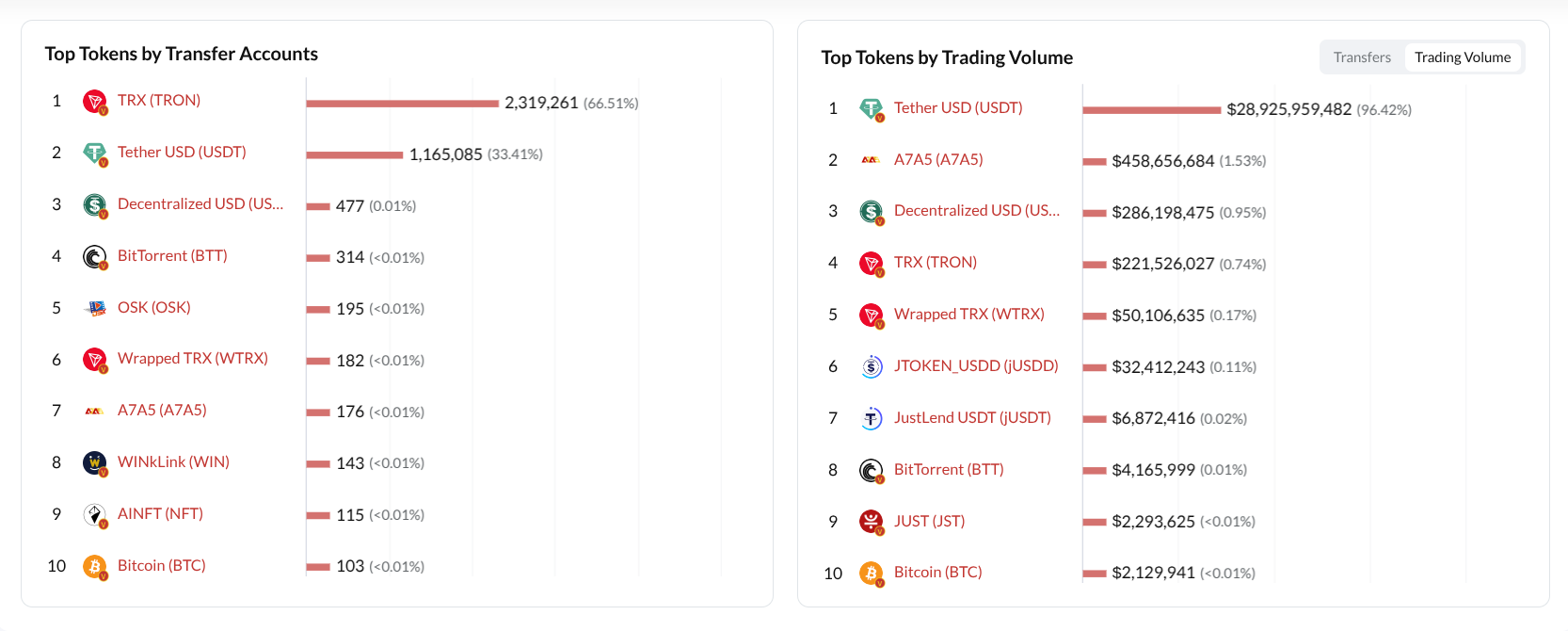
The screenshot I’m referring to comes from Tronscan. It shows that 96% of all volume is attributed to USDT. The site labels this as trading volume, but if that’s the case, it raises an obvious question: what exactly is USDT being traded against - and why don’t we see a comparable share for the counter asset? That’s why I still believe this figure actually reflects the total volume of all operations involving the asset.
For comparison, look at the tokens ranked second and third: A7A5 and USDD. What’s especially revealing is the column showing the number of accounts that made at least one transfer in the past 24 hours. A7A5 has 176 such accounts, and USDD has 477. Combined, that’s less than 0.02% of all daily active accounts.
TRON is incredibly lucky to have USDT embedded so deeply into its ecosystem. Without it, network activity would likely shrink to just a few hundred active accounts per day.
At the same time, it becomes clear how easy it is for a token to climb to second place by volume:
- spin up a few hundred accounts,
- issue a large supply of tokens to create the illusion of a ~$500M market cap,
- move those tokens back and forth between those accounts,
- and then report to investors that your token ranks #2 by daily volume on TRON.
In reality, nearly all transfer volume on the network is driven by USDT. Everything else is barely visible next to it.
I can confirm this from our own data at rabbit.io: we see virtually no demand for TRC20 tokens other than USDT. But USDT on TRON is consistently in high demand.